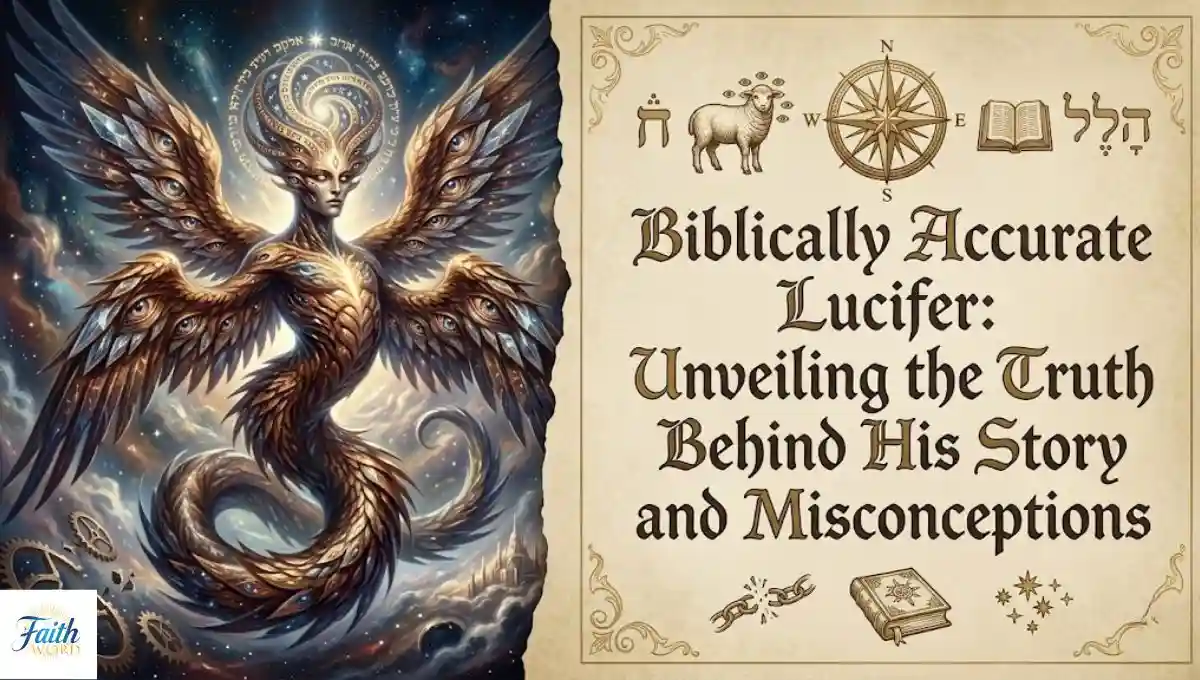
The figure of Lucifer in the Bible has fascinated theologians and believers for centuries, yet most people know him through cultural misconceptions rather than scripture. The biblically accurate Lucifer is described in Isaiah 14 as the Morning Star, a being of unparalleled beauty and power whose pride led to rebellion.
Understanding his story requires separating Hebrew Scripture from centuries of artistic and medieval depictions, revealing the fallen angel not as a red-horned monster but as a once-perfect creation whose corruption through pride became a timeless warning.
From Ezekiel’s description of angelic glory to the real meaning behind the Lucifer mistranslation, the Bible paints a far more complex and fascinating account than modern tradition has imagined.
Biblically Accurate Understanding of Lucifer’s Identity
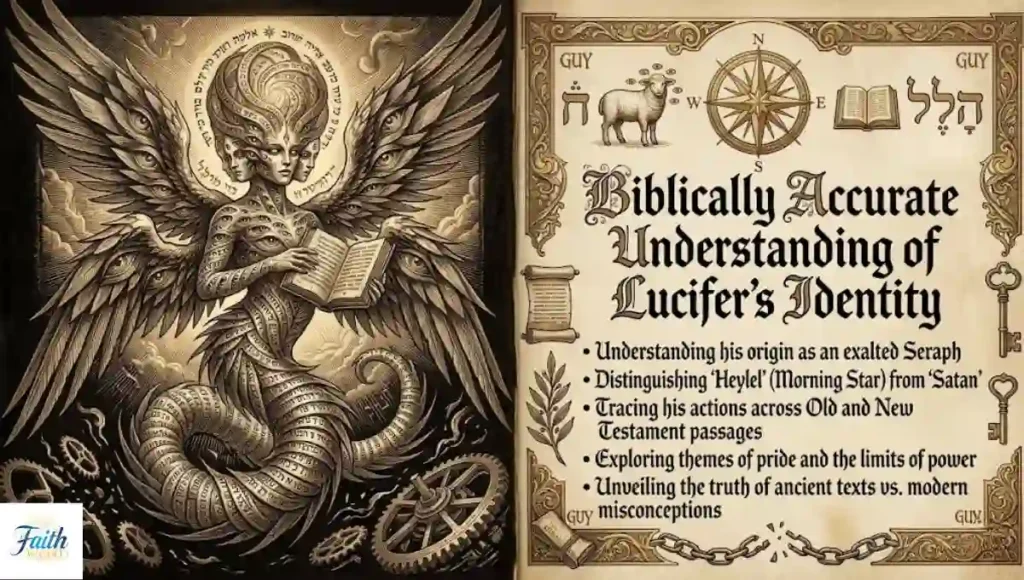
A biblically accurate understanding of Lucifer begins with one simple but powerful fact: the Bible never describes him as a red-horned monster. It describes something far more unsettling. A being of light, beauty, and terrifying power whose true identity has been obscured under centuries of tradition, mistranslation, and cultural imagination.
Common Misconceptions About Lucifer in Modern Culture
Modern culture has completely reshaped the image of Lucifer. What most people believe today comes from movies, mythology, and tradition rather than from the Bible. The gap between pop culture and biblical accuracy is far wider than most people realize. Here are the most common misconceptions:
• Lucifer is not described as red or horned anywhere in the Bible
• The names Satan and Lucifer are used interchangeably in culture, but scripture treats them as distinct
• Most people picture a ruler of hell, yet the Bible never assigns him that role
• The idea of Lucifer leading an army of angels is largely built on tradition, not direct scripture
• Hollywood has turned a complex biblical figure into a simple villain and most people accepted it without question
• The word Lucifer appears only once in the entire Bible, in Isaiah 14:12
Stripping away centuries of myth reveals something unexpected. The biblical truth about Lucifer is not what religion or entertainment has taught. A biblically accurate reading of scripture produces a very different picture entirely.
What Scripture Actually Reveals About Lucifer
Scripture does not describe a monster in red. It describes a being of breathtaking beauty and heavenly power who once stood closer to God than almost anyone else. The word Lucifer in the Bible appears exactly once. That single appearance in Isaiah 14:12 holds the key to understanding who and what this figure truly represents. What makes his story so powerful is not his evil, but what he once was before the fall.
How you have fallen from heaven, O morning star, son of the dawn. You have been cast down to earth, you who once laid low the nations. Isaiah 14:12
The Hebrew Original: Helel and Its True Meaning
The original Hebrew word behind Isaiah 14:12 is not Lucifer. It is Helel. This single Hebrew term is the foundation of the entire Lucifer in the Bible discussion. Understanding Helel ben Shachar meaning is essential for any biblically accurate study of this topic. Scholarly research confirms that the word Helel appears only once in the entire Hebrew Bible, making it one of the rarest and most debated terms in all of scripture.
| Term | Language | Meaning | Context |
| Helel | Hebrew | Shining One / Bright One | Isaiah 14:12 original text |
| Lucifer | Latin | Light Bearer / Morning Star | Jerome’s Vulgate (383 AD) |
| Eosphoros | Greek (LXX) | Dawn Bringer | Septuagint translation |
| Morning Star | English | Brightest star before sunrise | Most modern translations |
| Phosphoros | Greek | Light Bringer | New Testament reference |
| Satan | Hebrew | Adversary / Accuser | Post-fall identity in scripture |
Biblical scholars at institutions including Israel Bible Center confirm that Helel ben Shachar translates most accurately as shining one, son of dawn. The Hebrew word derives from the root halal, meaning to shine or to radiate. This astronomical imagery pointed directly to the planet Venus as the morning star, which shines brilliantly just before sunrise then disappears as the sun rises. The symbolism was intentional and powerfully poetic.
Jerome’s Latin Vulgate and the Birth of ‘Lucifer’
Most people are unaware that the word Lucifer was introduced into Christianity through a single translation decision. Around 383 AD, the scholar Jerome translated the Bible into Latin in what became known as the Vulgate. When Jerome reached Isaiah 14:12, he rendered the Hebrew Helel as the Latin word Lucifer, meaning light bearer or morning star. It was never intended as a proper name. It was a descriptive translation that the world slowly transformed into a personal identity.
How you have fallen from heaven, O Lucifer, son of the morning. Isaiah 14:12, Latin Vulgate (Jerome, 383 AD)
Notably, as 2 Corinthians 11:14 warns, Satan himself masquerades as an angel of light. Jerome actually used the Latin word Lucifer twice in his translation, once for the fallen figure in Isaiah and once for Jesus Christ in 2 Peter 1:19, where the morning star is a title of glory. That parallel is one of the most overlooked facts in the entire biblical Lucifer meaning debate.
King James Translation and English Christian Tradition
In 1611, the King James Bible was completed. Translators kept the Latin word Lucifer from Jerome’s Vulgate rather than rendering the original Hebrew. That single editorial decision shaped English Christian tradition for over four centuries and permanently embedded the name into Western religious consciousness. The table below shows how different Bible versions have handled this translation:
| Bible Version | Year | Translation of Helel | Notes |
| Hebrew Original | Ancient | Helel / Shining One | Direct astronomical reference |
| Septuagint (LXX) | ~250 BC | Eosphoros / Dawn Bringer | Greek Old Testament |
| Latin Vulgate | 383 AD | Lucifer / Light Bearer | Jerome’s translation |
| King James Version | 1611 | Lucifer (kept as name) | Shaped 400 years of tradition |
| New International Version | 1978 | Morning Star | Returns to original imagery |
| English Standard Version | 2001 | Day Star | Modern scholarly translation |
| New Living Translation | 1996 | Shining Star | Contemporary rendering |
Modern translations including the NIV, ESV, and NLT have all corrected this, replacing Lucifer with Morning Star, Day Star, or Shining Star to reflect the original Hebrew intent. But for millions raised on the King James Version, the word Lucifer had already become synonymous with the devil himself. The myth had taken root long before the correction arrived.
See More : Tyler Name Meaning in Bible: Origin, Faith & Symbolism Hello World
Biblically Accurate Description of Lucifer’s Appearance
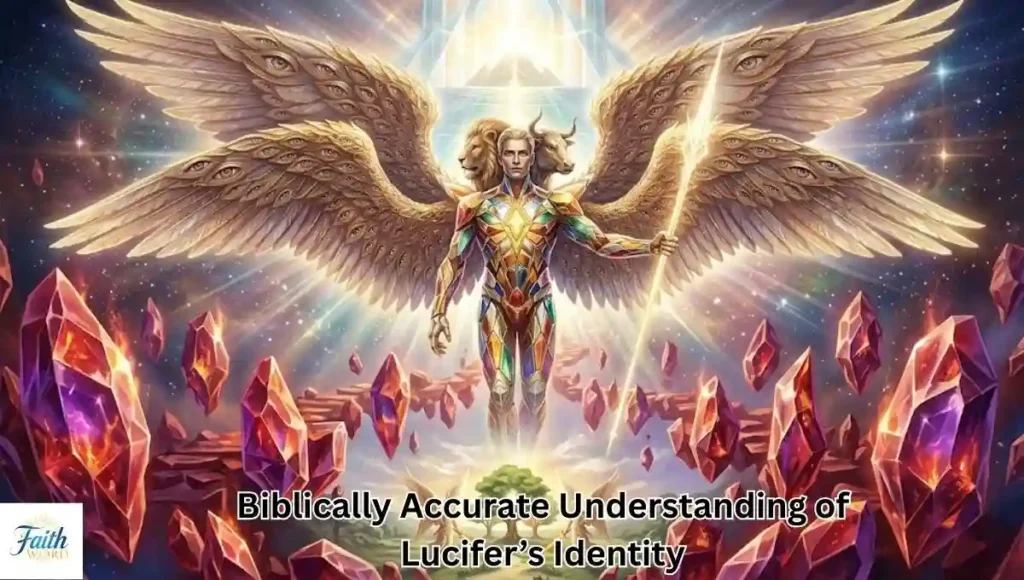
A biblically accurate description of Lucifer bears almost no resemblance to what popular culture depicts. Scripture never paints this figure as dark or monstrous. Instead, it describes a being of breathtaking beauty and radiant light, so perfect in form that his very appearance reflected the glory of God himself. This is the Lucifer in the Bible that most people have never been shown.
Lucifer’s Pre-Fall Glory According to Ezekiel
The most detailed pre-fall description of Lucifer in scripture appears in Ezekiel 28:12-17. While the passage addresses the king of Tyre on the surface, theologians across centuries have recognized it as describing a spiritual reality far beyond any earthly king. This is the biblically accurate portrait of Lucifer before his rebellion:
You were the seal of perfection, full of wisdom and perfect in beauty. Ezekiel 28:12
Ezekiel 28 describes Lucifer’s pre-fall glory with remarkable detail. Here are the specific attributes scripture assigns to him:
• Perfect in beauty unlike any other created being in existence
• Filled with wisdom beyond all measure given by God himself
• Dwelled in the Garden of Eden among the most sacred places
• Covered in nine precious stones including ruby, topaz, and diamond
• Walked on the holy mountain of God in divine proximity
• Moved among the stones of fire, a place of pure divine glory
• Anointed as a covering cherub, specially chosen and set apart by God
This was not a creature of darkness. This was the most glorious of God’s creations, a being of light, wisdom, and heavenly beauty. Understanding what he once was makes his fall not simply a story of evil but a deeply haunting tale of how pride can destroy something truly magnificent.
The Morning Star Imagery in Isaiah’s Prophecy
The Morning Star Bible imagery in Isaiah 14 is one of the most powerful metaphors in all of scripture. The morning star, the planet Venus, is the brightest light visible in the sky just before sunrise. It outshines everything around it, then disappears when the sun ascends. Isaiah used this image deliberately to capture what Lucifer once was and what he lost.
• The Morning Star symbolized beauty, supreme power, and the highest heavenly position
• Lucifer’s fall is pictured as the brightest star being violently cast down from the sky
• His pride convinced him he could ascend above God himself
• The same title, Morning Star, is later given to Jesus Christ in Revelation 22:16
What Lucifer lost through pride, Jesus reclaimed through humility. That contrast sits at the very heart of the biblical narrative and it is far more theologically powerful than any cultural myth ever constructed around this figure.
Does Lucifer Possess Physical Form After His Fall
After the fall, Isaiah 14:11 paints a very different picture. The glory and beauty Lucifer once carried were stripped away the moment pride replaced purpose. The Bible does not clearly confirm whether Lucifer has a physical form after his fall. What it does reveal is that he operates as a spiritual being, moving and influencing without a fixed physical body. He is described through multiple images, none of which suggest a single physical form:
| Biblical Description | Scripture | Spiritual Meaning |
| Roaring Lion | 1 Peter 5:8 | A predator always hunting human souls |
| Angel of Light | 2 Corinthians 11:14 | Appears beautiful and deeply deceptive |
| Ancient Serpent | Revelation 12:9 | Cunning and spiritually dangerous |
| Prince of the Air | Ephesians 2:2 | Unseen spiritual presence and influence |
| Dragon | Revelation 12:3 | Immense power and destructive authority |
The Bible uses many images to describe Lucifer after the fall, but none of them represent a fixed physical form in the way humans understand physicality. He is a spiritual force and that makes him far more dangerous than any creature with a body. You cannot fight what you cannot see with natural eyes.
What Biblical Silence Tells Us Lucifer Is Not
Sometimes the most powerful truth is found in what the Bible does not say. Biblical silence on certain details about Lucifer is itself a correction waiting to be heard. Here is what scripture never once describes about this figure:
• The Bible never describes him as red or as having horns of any kind
• He is never called the ruler or king of hell anywhere in scripture
• He is never shown carrying a pitchfork or living in flames as a permanent resident
• The Bible never says he controls hell as his domain, he is actually destined for punishment there
• He is never portrayed as the opposite or equal of God in any biblical text
• Scripture never gives him a physical body with wings after the fall
The image most people carry of Lucifer was painted by culture, not scripture. The Bible’s silence on these details is itself a profound message. The most dangerous deception never looks like a red-horned monster. According to 2 Corinthians 11:14, it looks like an angel of light.
Symbolism and Meaning Behind Lucifer’s Role in Biblical Texts
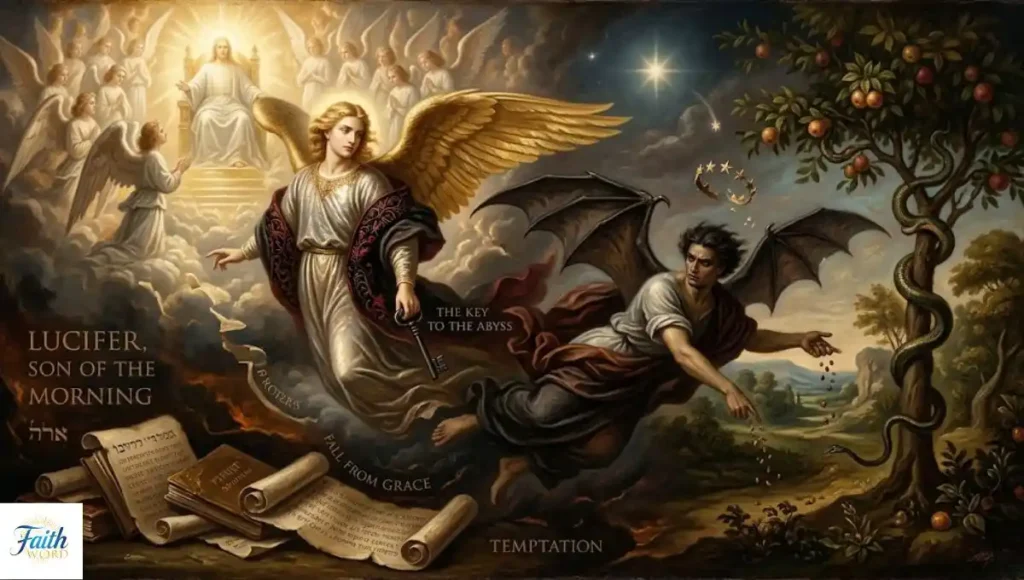
Beyond the question of identity and appearance, the biblical figure of Lucifer carries deep symbolic weight across multiple books of scripture. His role functions as a theological anchor for understanding the origin of pride, the nature of spiritual rebellion, and the cosmic consequences of choosing self over God. A biblically accurate reading of his role reveals three primary symbolic dimensions.
First, Lucifer functions as the archetypal symbol of pride. His story in Isaiah 14 and Ezekiel 28 is not primarily about a named individual but about the universal human and spiritual temptation to place oneself above the Creator. Second, the morning star imagery symbolizes misplaced glory. Just as the morning star briefly outshines everything before the sun renders it invisible, Lucifer’s brilliance existed only in the shadow of God’s greater light. The moment he sought to replace that light, he was extinguished.
Third, Lucifer’s role in scripture functions as a warning narrative. The Bible returns again and again to the theme of pride before destruction, and his story is the supreme illustration. Proverbs 16:18 declares that pride goes before destruction and a haughty spirit before a fall. Lucifer is the living proof, preserved in scripture as a permanent cautionary example for every human heart.
Common Misinterpretations About Lucifer in Modern Culture
Beyond the obvious visual misconceptions, several deeper theological misinterpretations have taken hold in modern culture regarding Lucifer in the Bible. These errors go beyond red skin and horns. They affect how people understand evil, spiritual warfare, and the nature of God himself.
One of the most widespread misinterpretations is the idea that Lucifer and God are equal and opposite forces locked in eternal battle. This dualistic view has no biblical foundation whatsoever. Scripture consistently portrays God as the unchallenged sovereign. Lucifer is a created being, powerful but finite, already defeated and already sentenced. The battle is not between equals.
Another common misinterpretation is that Lucifer rules over hell as his domain. In reality, scripture teaches the opposite. Hell was created as a place of punishment for the devil and his angels (Matthew 25:41). He does not reign there. He will be imprisoned there. The ruler of hell image belongs entirely to cultural imagination, not to biblical accuracy.
A third major misinterpretation involves the idea that Lucifer is primarily interested in tempting people toward obvious evil. Scripture paints a subtler and more dangerous picture. His primary strategy, as described in 2 Corinthians 11:14, is deception through appearing as an angel of light. The biblically accurate Lucifer is not a villain who announces himself. He is a deceiver who presents himself as helpful, enlightened, and trustworthy.
Critical Distinction Between Lucifer and Satan in Scripture
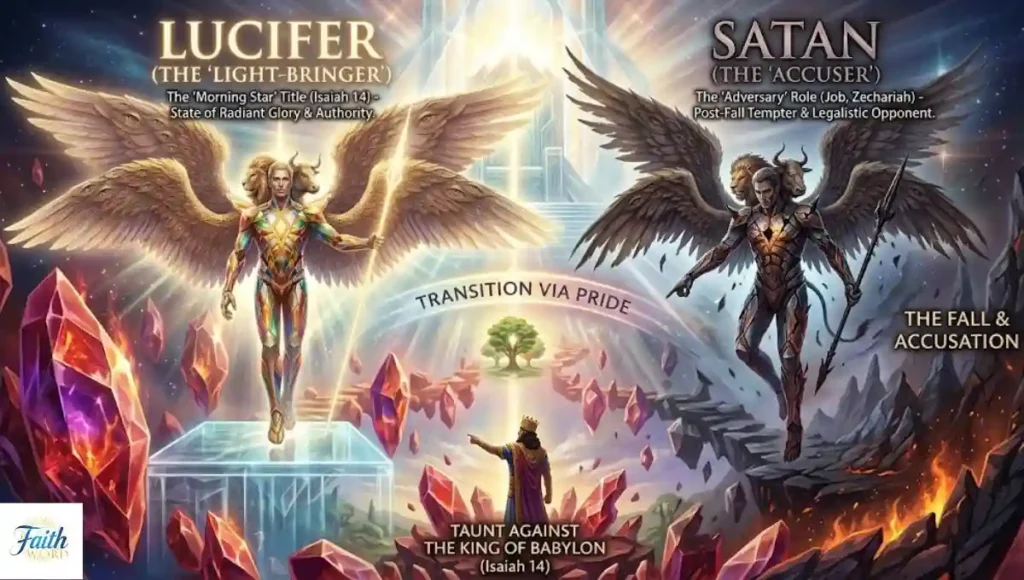
Most people use Lucifer and Satan as the same name. But a biblically accurate reading of scripture reveals that the Bible never directly equates the two. Lucifer describes what this being was before the fall. Satan describes what he became after it. That distinction is not academic. It fundamentally shapes how we understand both biblical identity and the nature of spiritual evil.
Biblical Evidence Supporting Their Distinction
Isaiah 14:12 describes a being of light and glory designated by the term that Jerome translated as Lucifer. Job 1:6 then shows us Satan, an accuser standing before God to attack an innocent man named Job. These two portraits are strikingly different and separated by the transformative event of the fall itself.
| Attribute | Lucifer | Satan |
| Name Meaning | Light Bearer / Morning Star | Adversary / Accuser |
| Nature | Beautiful, Glorious, Perfect | Deceptive, Destructive, Corrupt |
| Primary Texts | Isaiah 14 / Ezekiel 28 | Job 1 / Revelation 12 / Matthew 4 |
| Assigned Role | Anointed Covering Angel | Accuser, Tempter, Deceiver |
| Time Period | Pre-Fall Existence | Post-Fall Activity |
| Primary Symbol | Morning Star | Serpent, Dragon, Roaring Lion |
The Bible uses two very different pictures for a deliberate reason. Lucifer represents the glory of what was created. Satan represents the ruin of what was chosen through pride. Understanding that difference is not merely interesting. It is essential to grasping the full biblical truth about spiritual evil.
How Christian Tradition Merged These Figures
For centuries, Christian tradition gradually blended Lucifer and Satan into one single identity. This merging did not happen overnight. It developed through sermons, paintings, theological commentaries, and literary works that built on each other over hundreds of years. By the time the Middle Ages arrived, the identification was nearly complete.
The most influential works cementing this merger were literary, not biblical. Dante Alighieri’s Inferno, written in the early 14th century, depicted Lucifer as the frozen, monstrous prisoner at the center of hell. John Milton’s Paradise Lost in 1667 portrayed him as a complex, tragic rebel. These masterworks were literature, not scripture. But millions absorbed them as theological truth, and the confusion became cultural standard.
Protestant Reformers’ Rejection of the Equation
When the Protestant Reformation began in the 16th century, some reformers returned to original Hebrew and Greek texts and questioned what the Church had taught for centuries. Martin Luther himself raised doubts about how Isaiah 14 had been interpreted, arguing the passage was primarily a political taunt against the King of Babylon rather than a literal cosmic biography of a fallen angel. That position represented a significant departure from centuries of accepted tradition.
Other reformers followed similar paths, questioning traditions that lacked strong biblical foundation. They did not all agree with one another. But they cracked open a door that had been shut for centuries and forced the question to be asked openly: does the Bible actually say what tradition claims it says about Lucifer?
Why This Theological Distinction Matters Today
Understanding the Lucifer vs Satan difference is not merely a historical debate. It directly affects how people read and interpret their Bible. When tradition replaces scripture, the foundation of belief shifts without anyone noticing the movement beneath their feet.
Getting this distinction right changes how people understand evil, pride, and spiritual danger. The biblical truth is not just about a name. It is about recognizing how corruption enters something beautiful and destroys it from within. That lesson about pride in scripture is just as relevant and urgent today as it was thousands of years ago when Isaiah first wrote his prophetic taunt.
Biblically Accurate Account of Lucifer’s Fall and Significance
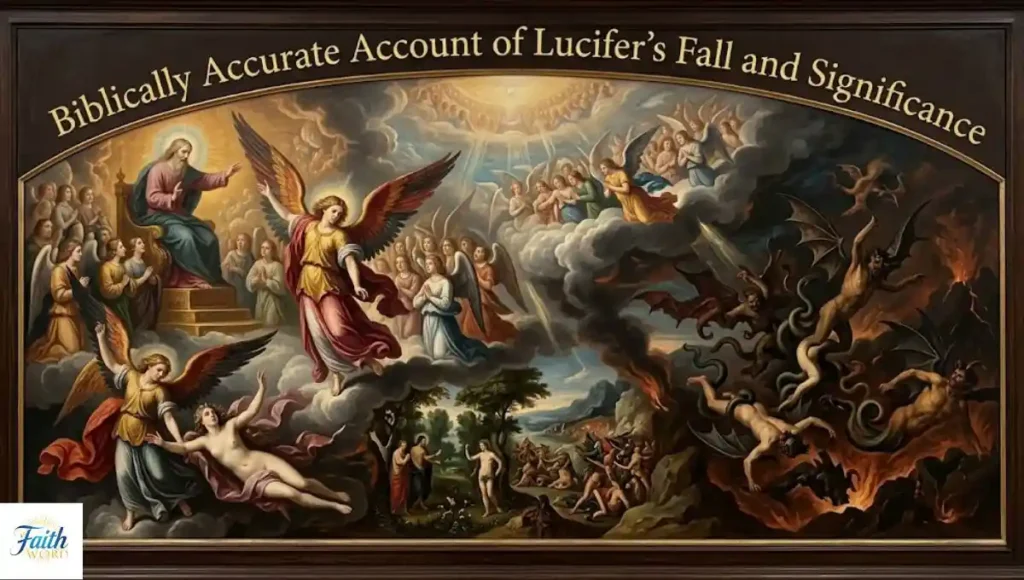
The biblically accurate account of Lucifer’s fall is not mythology or legend. It is woven across multiple books of the Bible and confirmed by the words of Jesus himself. This is the most dramatic and consequential event in spiritual history before the creation of humanity, and its implications echo through every page of scripture that follows.
The Narrative of the Fallen Angel in Scripture
The fallen angel narrative in scripture is not limited to one book or one verse. It is a thread running through Isaiah, Ezekiel, Luke, Revelation, Job, and 2 Peter. Each text adds another dimension to the complete picture. Together they tell the story of the greatest fall in all of creation:
| Scripture | What It Reveals |
| Isaiah 14:12-15 | His fall from heaven described through Morning Star imagery |
| Ezekiel 28:15-17 | Pride and beauty led to corruption and being cast out |
| Luke 10:18 | Jesus personally confirms seeing him fall like lightning from heaven |
| Revelation 12:7-9 | War in heaven; he was cast down along with his angels |
| Job 1:6 | He retains access to God’s presence even after the fall |
| 2 Peter 2:4 | Fallen angels were cast into darkness and held for judgment |
I saw Satan fall like lightning from heaven. Luke 10:18, Jesus speaking to his disciples
Lucifer’s Five ‘I Will’ Declarations of Pride
Isaiah 14:13-14 records what may be the most dangerous words ever spoken in the spiritual realm. Five times, the fallen being declared I will, each statement a direct act of defiance against God. These were not idle thoughts or momentary impulses. They were calculated declarations of pride that set the entire fall in motion:
1. I will ascend to heaven: a declaration to leave his appointed position and status
2. I will raise my throne above the stars of God: a claim to authority over all other angels
3. I will sit on the mount of the congregation: a demand for worship belonging only to God
4. I will ascend above the heights of the clouds: a desire to surpass divine glory itself
5. I will make myself like the Most High: the ultimate act of pride and cosmic rebellion
Five declarations. Five acts of pride. Every single one was answered with a catastrophic fall. The lesson of this passage is unmistakable. The moment any created being places self before God, destruction is already on its way. This is the core of the biblical account of pride and it applies with equal force to human hearts today.
The Nature of Sin: Pride in God-Given Perfection
Lucifer did not fall because he was weak or broken. He fell because he was perfect and he knew it. Pride entered the moment he shifted his gaze from the Creator to his own reflection. This is what makes his story so haunting. Ezekiel 28:17 states plainly that his heart became proud on account of his beauty. The very gifts God had given him became the instruments of his destruction.
This is the specific warning that biblical theology of evil centers on. Pride does not grow in emptiness. It grows in greatness. The more gifted the individual, the more powerful the position, the louder the whisper of pride becomes. Lucifer heard that whisper and chose to amplify it, and it cost him everything.
Catastrophic Consequences of Angelic Rebellion
The consequences of the angelic rebellion were immediate, total, and eternal. God cast him out of heaven with a swiftness that reveals how seriously rebellion is treated in the spiritual realm. There was no second chance, no warning period, no rehabilitation plan. The fall was final and the consequences permanent.
The damage extended far beyond Lucifer himself. Revelation 12:4 indicates that a third of the stars of heaven, widely understood as a third of all angels, were swept away in his rebellion. One act of pride did not simply destroy a single being. It shattered an entire portion of God’s creation and launched a spiritual war that scripture says continues to this day.
The Scope of Rebellion: One-Third of Angels
The scale of the angelic rebellion described in Revelation 12:4 is almost impossible to fully grasp. A third of all angels, powerful and glorious beings who knew God directly, chose to follow Lucifer into rebellion knowing exactly what they were doing. This was not confusion or ignorance. It was deliberate defiance at a cosmic scale.
This biblical fact about Lucifer’s influence is sobering. He did not simply fall alone. He took multitudes with him. That capacity to draw others into corruption is precisely why Ephesians 6:12 describes an entire hierarchy of spiritual powers arrayed against humanity, the direct legacy of one being’s pride.
Artistic Evolution of Lucifer’s Image Throughout History
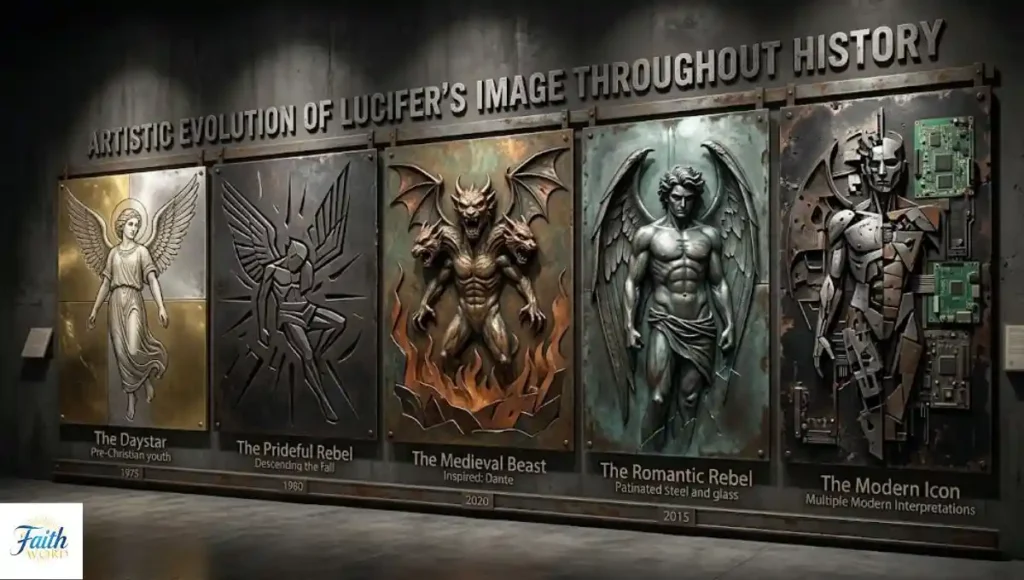
The Lucifer most people picture today was not drawn from the Bible. He was drawn from paintings, poems, and imagination. Over centuries, artists and writers gradually replaced the biblically accurate figure with something far more dramatic and far less scripturally grounded. Tracking this evolution reveals how thoroughly cultural forces can reshape religious understanding.
Early Medieval Period: The Ethereal Blue Angel
In the Early Medieval Period, artistic depictions of Lucifer looked nothing like what we see today. He was often painted as a blue or pale luminous angel, still carrying traces of his heavenly origin. Artists of that era stayed closer to the biblical description of a being made of light and beauty. These early images reflected a deeper theological understanding. The figure was portrayed as a glorious being who made a terrible choice, which is far closer to the biblically accurate description than anything that came after.
High Medieval Transformation to Grotesque Forms
As the Middle Ages progressed, Lucifer’s image changed dramatically. Church authorities and artists began portraying him as a grotesque, monstrous creature with horns, claws, and terrifying deformities. The purpose was practical: make evil look repulsive so people would fear and avoid it. By the High Medieval Period, Dante’s Inferno had cemented this transformation, depicting a giant frozen three-headed monster trapped at the center of hell. It was powerful imagery and it had almost nothing to do with what the Bible actually says.
Renaissance Romanticization: Milton’s Tragic Rebel
The Renaissance introduced a completely different version of Lucifer. Artists and writers moved away from the grotesque monster of the Middle Ages toward something far more dangerous: a beautiful, tragic, and almost sympathetic figure. John Milton’s Paradise Lost, written in 1667, gave the world its most enduring cultural image. Milton’s Lucifer was a complex rebel, proud, passionate, and almost heroic in his defiance.
Milton’s Paradise Lost Lucifer is literary genius but not biblical accuracy. Yet millions of readers absorbed it as though it were scripture. That romanticized image of a tragic rebel quietly replaced the biblical truth in the minds of countless people and its influence continues to shape art, film, and culture to this day.
Victorian Era Through Modern: The Theatrical Red Devil
The Victorian Era took the romanticized image and amplified it further. Lucifer began appearing in theatre and illustration as a red-skinned horned figure carrying a pitchfork. This Victorian devil imagery was dramatic and memorable but almost entirely fictional. Much of it was borrowed directly from pre-Christian pagan mythology, not from the Bible. Artists blended ancient horned deities with loose biblical references to create something that felt religious but was rooted in pure imagination.
By the modern era, Hollywood had taken full creative control. Films and television series transformed Lucifer into everything from a terrifying cosmic villain to a charming sophisticated antihero. With each passing decade, the cultural Lucifer misconceptions grew wider and harder to correct.
Contrasts Between Artistic and Biblical Portrayals
The difference between what the Bible says and what art has created is not minor. It is enormous in almost every detail:
| Category | Biblical Portrayal | Artistic / Cultural Portrayal |
| Appearance | Being of light and radiant beauty | Red skin, horns, monstrous form |
| Color | Luminous, associated with light | Red or dark, associated with evil |
| Physical Features | No horns mentioned anywhere | Horns as signature feature |
| Location | Destined for punishment in hell | Ruler and king of hell |
| Primary Warning | Appears as angel of light (2 Cor 11:14) | Obviously terrifying and dark |
| Core Focus | Pride and spiritual corruption | Dramatic external appearance |
The danger of letting Lucifer artistic depictions replace scripture is that it makes evil easier to dismiss. When people picture a red-horned monster, they stop looking for the real figure the Bible warns about. The most dangerous deception never announces itself with horns and a pitchfork. According to scripture, it comes dressed in light.
Theological Insights from a Biblically Accurate Lucifer
A biblically accurate understanding of Lucifer unlocks something far deeper than a story about evil. It reveals foundational truths about the nature of pride, the gift of free will, the origin of sin, and what happens when a created being chooses self above God. These theological lessons from Lucifer’s story are as urgently relevant today as they were in the beginning.
The Paradox of Created Perfection and Free Will
God created Lucifer perfect. That fact creates one of the deepest paradoxes in all of theology. If he was perfect, why did he fall? The answer lies in the most powerful gift God gave every created being: genuine freedom of choice. Free will is not a flaw in divine design. It is the highest expression of divine love. But it carries the greatest possible risk. Even a being of perfect beauty and heavenly wisdom could use that freedom to choose pride over purpose and that is exactly what Lucifer did.
That is the real paradox at the heart of this story. Perfection did not protect him. Wisdom did not save him. Only humility and surrender to God could have done that, and he chose neither. That choice echoes through all of human history and every individual human heart right up to the present day.
The Origin of Evil Within a Perfect Being
One of the deepest questions in all of biblical theology is this: how did evil begin inside a being that God created perfect? Ezekiel 28:15 provides the answer with devastating precision: You were blameless in your ways from the day you were created, till unrighteousness was found in you. Evil did not come from outside Lucifer. It was born from within through a single act of misplaced desire.
The origin of evil was not a flaw in creation. It was a moment of choice. Lucifer looked at his own beauty, his own wisdom, his own heavenly position, and decided these belonged to him rather than to God. That single internal shift from gratitude to pride was the moment evil entered a perfect being and changed everything forever.
Pride’s Specific Temptation: Giftedness and Position
Lucifer was not tempted by poverty or powerlessness. He was tempted by his own giftedness. The very attributes God had given him became the exact tools that pride used to destroy him. That is a warning far deeper than most people appreciate.
This is the specific danger of pride in scripture: it does not grow in people who have nothing. It grows in people who have been given much. The higher the position, the greater the gifting, the louder the whisper of pride becomes. That warning applies directly to every gifted, talented, and positioned human being who has ever lived. Lucifer heard that whisper and chose to listen. It cost him everything.
Cosmic Implications: Corrupting Others and Spiritual Warfare
Lucifer’s fall was never simply personal. The moment he rebelled, he began drawing others into his rebellion. A third of all angels followed him according to Revelation 12:4. Then he turned his attention toward humanity. His corruption did not stay contained in heaven. It spilled into every corner of God’s creation and launched a conflict that scripture describes as ongoing.
For we do not wrestle against flesh and blood, but against principalities, against powers, against the rulers of the darkness of this age. Ephesians 6:12
The fall of Lucifer did not end a conflict. It started one. And according to scripture, that spiritual warfare continues today. Understanding the biblically accurate Lucifer provides the essential context for understanding why spiritual warfare exists, what its origins are, and why humility before God is not optional but essential.
Lessons for Humanity: Humility and Dependence on God
The story of Lucifer is ultimately a lesson written for every human being. If pride could destroy the most glorious being God ever created, it can destroy anyone regardless of gifts, position, or spiritual history. The Bible uses his fall as the supreme warning against placing self above God in any area of life.
Pride goes before destruction, a haughty spirit before a fall. Proverbs 16:18
The biblical antidote is simple but profoundly demanding: genuine humility and total dependence on God. Lucifer is the living proof of Proverbs 16:18. His story is not ancient history disconnected from modern life. It is a mirror held up to every human heart that has ever been tempted to believe its own gifts make it self-sufficient.
Last Words
The biblically accurate story of Lucifer found in Isaiah 14, Ezekiel 28, and Revelation is far more powerful and personally relevant than centuries of myth, art, and cultural imagination have allowed most people to see.
He is not a red-horned monster but scripture’s supreme warning: pride destroys even the most perfect, and gifts without gratitude become the path to ruin.
Choose humility, stay close to God, and never let your gifts become your god the timeless biblical warning of the fallen morning star.
Frequently Asked Questions
What does the Bible say about Lucifer?
The Bible mentions Lucifer only once in Isaiah 14:12, describing a glorious being of light who fell from heaven through pride.
What are the differences between Lucifer and Satan in scripture?
Lucifer describes his glorious pre-fall identity in Isaiah 14, while Satan describes his post-fall role as adversary and accuser in Job 1 and Revelation 12.
Who was Lucifer before the fall?
Before the fall, Lucifer was the seal of perfection in Ezekiel 28, an anointed covering cherub of flawless beauty and wisdom on the holy mountain of God.
How did pride cause Lucifer’s fall?
Pride over his God-given beauty (Ezekiel 28:17) drove his five I will declarations in Isaiah 14:13-14, leading directly to his permanent expulsion from heaven.
How did art change the perception of Lucifer?
Art progressively replaced the biblically accurate luminous figure with a grotesque medieval monster, then Milton’s romantic rebel, and finally Hollywood’s charming antihero.

Welcome to Thefaithword! I’m Abdul Mannan Haider. Christian Faith Writer | 10+ Years Bible Study Experience | Founder of (thefaithword.com)
Sharing prayers, blessings, and biblical wisdom to strengthen your faith.