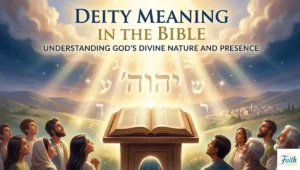
There are words that carry entire theological worlds inside them. “Deity” is one of those words. For Christians, it is not merely a vocabulary term from a philosophy textbook or a word borrowed from mythology. It is the foundation of everything.
The deity meaning in the Bible shapes how believers understand God, how they pray, why they worship, and what gives salvation its power.
Without a clear grasp of what deity truly means in Scripture, faith risks becoming shallow, detached from the God who is actually there.
This article explores the deity meaning in full biblical depth. From the precise Greek terms used in Scripture to the person of Jesus Christ, from the mystery of the Trinity to the practical daily implications of knowing and worshipping a truly divine God, every section of this guide is designed to bring you into a deeper, more grounded understanding of God’s divine nature and presence.
Biblical Meaning of Deity
1. Definition of Deity in the Bible
The word “deity” carries an ancient and weighty lineage. The word deity means “divine nature.” It was coined by Saint Augustine, a theologian whose writings were very influential in the shaping of Western Christianity. Deity comes from the Latin word for “god”: deus. The divine nature of deities is believed to be immortal goodness and powerfulness.
In the Greek New Testament, the most important word for deity meaning is theotes (θεότης), used directly in Colossians 2:9, where Paul writes: “For in Christ all the fullness of the Deity lives in bodily form.” This is not merely a description of qualities that resemble God. It is a declaration that the complete, undiminished essence of God Himself dwells in Jesus Christ.
The Greek New Testament uses Theos (θεός) to mean “God,” referring specifically to the one true God of Abraham, Isaac, and Jacob, and Jesus. This term appears over 1,300 times in the New Testament, establishing it as the primary biblical designation for the One Almighty God.
Webster’s 1828 Dictionary defines deity as: “Godhead; divinity; the nature and essence of the Supreme Being; as, the deity of the Supreme Being is manifest in his works.”
So when we speak of deity meaning in the Bible, we are speaking of the complete package of God’s nature: His eternal existence, His omnipotence, His omniscience, His holiness, His sovereignty, and His absolute supremacy over all creation. It is everything God is, in His fullness, without diminishment.
Read More : Ava Name Meaning in Bible: A Gentle Message of Life and Hope
Key characteristics that define the deity meaning in Scripture:
- Eternal: God exists outside of time, without beginning or end (Psalm 90:2, Revelation 1:8)
- Omnipotent: God possesses all power over all things (Jeremiah 32:17, Matthew 19:26)
- Omniscient: God knows all things completely (Psalm 139:1-4, Romans 11:33)
- Omnipresent: God is fully present everywhere simultaneously (Psalm 139:7-10, Jeremiah 23:24)
- Holy: God is perfectly pure, utterly set apart from all sin (Isaiah 6:3, Revelation 4:8)
- Immutable: God does not change (Malachi 3:6, Hebrews 13:8)
- Self-existent: God depends on nothing outside Himself for His existence (Exodus 3:14)
2. Deity of God the Father
The deity meaning as it applies to God the Father is the starting point of all biblical theology. The Old Testament is relentlessly clear on this: there is one God, the Creator of heaven and earth, sovereign over all nations, all history, and all creation.
“I am the LORD, and there is no other; apart from me there is no God.” (Isaiah 45:5, NIV)
“In the beginning God created the heavens and the earth.” (Genesis 1:1, NIV)
The deity of God the Father is not a theological abstraction. It is the lived reality that frames every page of Scripture. He is not a god among gods. He is not a divine principle or cosmic force. He is the living, personal, self-revealing God who spoke the universe into existence, who heard the cries of enslaved Israel, who parted seas and raised the dead, who loves His people with an everlasting love (Jeremiah 31:3).
The deity meaning of God the Father encompasses His role as:
- Creator: All things were made by Him and for Him (Genesis 1, Colossians 1:16)
- Sustainer: He holds all creation together by His power (Hebrews 1:3, Colossians 1:17)
- Lawgiver: His moral character defines all righteousness (Exodus 20, James 4:12)
- Judge: He alone has authority over eternal life and death (Genesis 18:25, Hebrews 12:23)
- Redeemer: His plan of salvation flows from His divine love and mercy (John 3:16, Ephesians 1:3-10)
3. Deity of Jesus Christ
No aspect of the deity meaning in the Bible is more important, more debated, and more glorious than the deity of Jesus Christ. This is not a secondary doctrine. The deity of Jesus is an essential doctrine of Christianity. The evidence that Jesus is God comes from several sources.
Jesus Christ existed prior to the creation of the universe, planets, light, and matter. He was with God and He was God, coeternal, coequal, and coexisting with the Holy Spirit and the Father.
John 1:1 states it without ambiguity: “In the beginning was the Word, and the Word was with God, and the Word was God.” This is one of the most theologically dense sentences in all of Scripture. The Word, who became flesh in Jesus Christ (John 1:14), was not merely associated with God. He was God.
The Bible ascribes to Jesus Christ the divine attributes of deity: eternal, omnipresent, omniscient, omnipotent, and immutable.
Paul’s persistent description of Jesus as savior is an implicit attribution of deity, since the Old Testament stresses that deliverance could only come from Yahweh, not man. Jesus’ divine nature was not something the early church invented after His death. Paul’s letters testify to belief in the full deity of Jesus Christ as the basic axiom of the church, not as a point of contention.
The clearest single verse for the deity meaning as it applies to Christ is Colossians 2:9: “For in Christ all the fullness of the Deity lives in bodily form.” The Greek word used here, theotes, means the totality of God’s divine being, not merely divine qualities or a divine appointment. Jesus does not reflect deity. Jesus is deity.
4. Deity and the Trinity
Modern orthodox Christians believe that the Trinity is composed of three equal, cosubstantial persons: God the Father, God the Son, and the Holy Spirit.
The Trinity is the fullest expression of deity meaning in the Bible. It is not three gods. It is not one God wearing three masks. It is one God eternally existing in three distinct persons, each fully possessing the divine nature, each coequal and coeternal with the others.
“Go therefore and make disciples of all nations, baptizing them in the name of the Father and of the Son and of the Holy Spirit.” (Matthew 28:19, ESV)
The three persons of the Trinity, Father, Son, and Holy Spirit, all share the same divine nature. But Jesus is unique because he is both fully God and fully human. And the doctrine of the deity of Jesus, the truth that he is fully God and fully man, is exclusive to Christianity.
| Person of the Trinity | Role in Scripture | Key Verse |
| God the Father | Creator, Sustainer, Lawgiver, Judge | Isaiah 45:5, John 3:16 |
| God the Son (Jesus) | Incarnate God, Savior, Mediator | John 1:1, Colossians 2:9 |
| God the Holy Spirit | Comforter, Sanctifier, Indwelling Presence | John 14:16-17, Romans 8:11 |
| All Three Together | One divine essence, three distinct persons | Matthew 28:19, 2 Corinthians 13:14 |
Understanding Deity in Worship and Prayer
The deity meaning is not merely a doctrine to believe. It is a reality that completely transforms how believers worship and pray. Genuine worship is only possible when directed at a genuinely divine Being. This is what Jesus meant when He said, “God is spirit, and his worshipers must worship in the Spirit and in truth.” (John 4:24, NIV)
Understanding the deity meaning in the context of worship means:
- Worship is not optional: Because God is deity in the fullest sense, worship is the only appropriate response of a creature before its Creator (Psalm 95:6-7, Revelation 4:11)
- Prayer reaches a God who can actually respond: When you pray, you are not sending a wish into the universe. You are speaking to the sovereign, all-knowing, all-powerful God who created the universe and who hears every word (Psalm 65:2, 1 John 5:14-15)
- Worship is grounded in truth: No wonder Thomas, confronted with the very tangible evidence of Jesus’ resurrection could say in response, “My Lord and my God” (John 20:28). We pray to Jesus as Lord, worship him and sing praises to him as God.
- Humility is the posture: Standing before deity in the biblical sense means recognizing the infinite distance between the Creator and the creature, and the miracle that this God desires relationship with us
When the deity meaning shapes your prayer life, prayer is no longer a religious duty performed for psychological comfort. It becomes a conversation with the Supreme Being of the universe who is simultaneously your Father, your Savior, and your Comforter.
The Deity of Christ in Bible Verses and Prophecy
The deity meaning as it applies to Jesus Christ is embedded throughout both the Old and New Testaments. It is not a late theological invention. It was anticipated in prophecy and declared at the incarnation.
Old Testament Prophecy Pointing to the Deity of Christ:
- Isaiah 9:6: “For to us a child is born, to us a son is given, and the government will be on his shoulders. And he will be called Wonderful Counselor, Mighty God, Everlasting Father, Prince of Peace.” The title “Mighty God” applied to the coming Messiah is an explicit declaration of deity.
- Micah 5:2: “But you, Bethlehem Ephrathah, though you are small among the clans of Judah, out of you will come for me one who will be ruler over Israel, whose origins are from of old, from ancient times.” Origins from ancient times points to pre-existence, a quality of deity.
- Isaiah 7:14: “Therefore the Lord himself will give you a sign: the virgin will conceive and give birth to a son, and will call him Immanuel.” Immanuel means “God with us,” a direct association of the coming child with God Himself.
New Testament Declarations of Christ’s Deity:
The verses John 1:1, 20:28; Romans 9:5; Philippians 2:6; Titus 2:13; Hebrews 1:8; and 1 John 5:20 explicitly declare that Jesus is a divine God in all the fullness of His glory.
| Bible Verse | What It Declares About Deity | Testament |
| John 1:1 | “The Word was God” | New |
| Colossians 2:9 | “All the fullness of the Deity lives in bodily form” | New |
| John 20:28 | Thomas: “My Lord and my God!” | New |
| Isaiah 9:6 | Messiah called “Mighty God” and “Everlasting Father” | Old |
| Hebrews 1:8 | God says to the Son: “Your throne, O God, will last forever” | New |
| Titus 2:13 | “Our great God and Savior, Jesus Christ” | New |
| Philippians 2:6 | Jesus “being in very nature God” | New |
| John 8:58 | Jesus: “Before Abraham was born, I am!” | New |
| Romans 9:5 | “Christ, who is God over all, forever praised” | New |
| Revelation 1:8 | “I am the Alpha and the Omega,” says the Lord God | New |
Only God is capable of being called the Creator (John 1:3; Colossians 1:16), only God can forgive sins (Mark 2:5-10; Colossians 3:13), only God can judge the world (Acts 10:42; 17:31), and only God can possess divinity. Jesus did all of these things, which is precisely why the church has confessed His deity from its earliest days.
Spiritual Significance and Symbolism of Deity
1. Deity as God’s Presence
One of the most intimate spiritual dimensions of the deity meaning is what it tells us about God’s presence. A God who is truly deity is not a distant philosophical concept or a religious idea. He is a living, present, knowable Being who chooses to dwell with His people.
“The virgin will conceive and give birth to a son, and they will call him Immanuel, which means ‘God with us.'” (Matthew 1:23, NIV)
This is the spiritual significance at the heart of the deity meaning: the God who created all things chose to become one of us. Jesus, who is God, stepped out of heaven, came into our reality, experienced human nature, took our breath, felt our suffering, and stood in our place. That is not something a mere prophet or teacher does. That is what deity does when it loves.
The Ark of the Covenant in the Old Testament was the physical symbol of God’s presence among Israel. The Temple in Jerusalem was where His glory dwelt. But with Jesus, something greater happened. God’s presence was not confined to a tent or a building. It walked among people, touched lepers, wept at tombs, and died on a cross.
2. Deity and Human Faith
Understanding the deity meaning does not diminish human faith; it gives faith its proper foundation. You cannot have saving faith in a non-divine Jesus. If Jesus is merely a great moral teacher, then belief in Him carries the same weight as belief in Confucius or Gandhi. Inspiring, perhaps, but not salvific.
Jesus needed to be divine to have the power to save us. This is not a small theological point. It is the axis on which the entire gospel turns. A human being can die as a martyr. Only God can die as a substitute for the sins of the entire world (1 John 2:2) and rise from the dead in victory.
The good news of the Christian faith is that all those who know this deity, this God, through His Son Jesus Christ will inherit eternal life (John 3:16). Getting this definition right is more than possessing head knowledge. It is a matter of eternal life or eternal death.
Faith rooted in the deity meaning is:
- Faith in a God powerful enough to actually rescue you
- Faith in a Savior who conquered death because He is life itself (John 11:25)
- Faith in a Comforter who is not limited by space or time (John 14:16-17)
- Faith in a God whose promises are backed by omnipotent authority
3. Transformation Through Knowing God
The deity meaning carries a transformative power that no human philosophy can replicate. When a person genuinely encounters the God who is truly deity, something changes that no human effort could produce.
Paul described it in 2 Corinthians 3:18: “And we all, who with unveiled faces contemplate the Lord’s glory, are being transformed into his image with ever-increasing glory, which comes from the Lord, who is the Spirit.”
Transformation through knowing God’s divine nature includes:
- A shift from self-centeredness to God-centeredness
- A growing capacity for love, patience, and forgiveness that originates from God’s own character
- A deepening peace that surpasses human understanding (Philippians 4:7)
- A growing confidence in prayer because the God you are praying to is truly all-powerful
- A freedom from fear, because the One who governs all things governs them with love and wisdom
Deity in Daily Life and Spiritual Experience
1. Recognizing God’s Deity in Life
The deity meaning is not confined to Sunday sermons or theological textbooks. It saturates everyday life for the believer who has eyes to see. Romans 1:20 states it plainly: “For since the creation of the world God’s invisible qualities, his eternal power and divine nature, have been clearly seen, being understood from what has been made.”
Recognizing God’s deity in daily life means:
- Seeing a sunrise and remembering the One who spoke light into existence
- Experiencing an unexpected provision and recognizing the hand of an omniscient God who knew your need before you did
- Walking through grief and finding a peace that has no natural explanation, only a supernatural source
- Making a difficult decision and sensing a clarity that did not come from your own wisdom
God’s deity means He is above everything, yet present in our lives. When believers understand God’s divine nature, their faith deepens.
2. Deity in Christian Belief
The deity meaning is the cornerstone of every major Christian doctrine. Remove it and the entire structure collapses:
| Christian Doctrine | How Deity Meaning Supports It |
| Salvation | Only God could bear the infinite weight of human sin |
| Resurrection | Only deity has power over death itself |
| Prayer | Only an omniscient, omnipresent God can hear and respond |
| Scripture | Only a divine Author could produce a book that transcends all cultures and centuries |
| The Church | Christ’s divine authority establishes and sustains it (Matthew 16:18) |
| Eternal Life | Only the Author of life can give life that never ends (John 11:25-26) |
| Moral Authority | Only divine character provides an absolute standard of right and wrong |
3. Responding to God’s Deity
The deity meaning, properly understood, demands a response. It is not information to simply file away. It is a truth that calls for the reorientation of an entire life. Here is how Scripture teaches believers to respond to the God who is truly deity:
- Worship: “Come, let us bow down in worship, let us kneel before the LORD our Maker.” (Psalm 95:6)
- Obedience: “Fear God and keep his commandments, for this is the duty of all mankind.” (Ecclesiastes 12:13)
- Trust: “Trust in the LORD with all your heart and lean not on your own understanding.” (Proverbs 3:5)
- Surrender: “Therefore, I urge you, brothers and sisters, in view of God’s mercy, to offer your bodies as a living sacrifice, holy and pleasing to God.” (Romans 12:1)
- Proclamation: “You are a chosen people, a royal priesthood, a holy nation, God’s special possession, that you may declare the praises of him who called you out of darkness into his wonderful light.” (1 Peter 2:9)
Practical Lessons & Faith Insights
The deity meaning Bible reveals is not meant to stay in the realm of academic theology. Here are the most grounded, practical faith lessons that flow from a true understanding of God’s divine nature:
1. Your God is big enough for your problem. Whatever you face today, you are not facing it with the help of a well-meaning but limited being. You are facing it with the omnipotent, omniscient, omnipresent God who created the universe. The deity meaning anchors your faith in Someone whose power has no ceiling.
2. Prayer is not a spiritual exercise. It is direct access to deity. The resurrected Jesus is still alive in heaven mediating between God and us (1 Timothy 2:5), continuously in God the Father’s presence, interceding for us (Hebrews 4:15), still representing us while powerfully sustaining our salvation. When you pray, you are reaching a God who hears, who cares, and who acts.
3. Doubt does not disqualify you. It can deepen you. Thomas doubted the resurrection until he met the risen Christ face to face and declared “My Lord and my God” (John 20:28). His doubt became the occasion for one of the most powerful declarations of the deity meaning in the entire Bible. Bring your doubts to the God who is deity and let Him answer them.
4. Holiness becomes possible through connection to a holy God. You cannot manufacture holiness through willpower. But when you are connected to the God who is deity, His Spirit works within you to produce what you cannot produce on your own (Philippians 2:13, Galatians 5:22-23).
5. The deity meaning sets Christianity apart from every other worldview. The servants of other deities remain dead. No one claims that Muhammad still walks the earth. The tomb of Jesus, however, remains empty. The New Testament is abundantly clear that Jesus rose from the dead, and no one has ever been able to produce His body. The resurrection of Christ is the ultimate proof of His deity, and it changes everything.
6. Understanding deity transforms how you handle suffering. A God who is truly deity is not surprised by your suffering. He is not powerless to help. And He is not absent. He is the God who entered suffering in the person of Jesus Christ, who “was despised and rejected by mankind, a man of suffering, and familiar with pain” (Isaiah 53:3). The deity meaning means you serve a God who understands your pain from the inside.
7. Eternal life is guaranteed by the power of deity. “I give them eternal life, and they shall never perish; no one will snatch them out of my hand.” (John 10:28, NIV). This promise carries the full weight of omnipotence behind it. The deity meaning is what makes the promise unbreakable.
Conclusion
The deity meaning in the Bible is the anchor of everything Christians believe, the foundation beneath every promise, and the source of every hope that makes faith more than wishful thinking.
From the thundering declaration of God’s eternal power in Genesis to the culminating vision of Christ’s majesty in Revelation, Scripture consistently reveals a God who is not merely great but absolutely divine, not merely helpful but supremely sovereign, not merely loving but the very definition of love itself.
Understanding the deity of God the Father, the deity of Jesus Christ, and the indwelling presence of the Holy Spirit transforms how you worship, how you pray, how you endure suffering, and how you live every ordinary day as a person held in the hands of an extraordinary God.
Let the deity meaning move from doctrine on a page to the living conviction that grounds your faith, fuels your worship, and gives every prayer you offer the confidence of speaking directly to the God who is, and was, and is to come.
FAQs About Deity Meaning in the Bible
Q1: What does deity mean in the Bible?
Deity means the complete divine nature of God, including His eternal power, holiness, omniscience, and supreme authority over all creation.
Q2: Is Jesus truly deity according to Scripture?
Yes, Colossians 2:9 declares that all the fullness of the Deity lives in Jesus Christ in bodily form, making Him fully God.
Q3: What is the difference between deity and divinity?
Both terms refer to God’s divine nature, but deity specifically describes the essence and totality of what God is in His supreme being.
Q4: How does the Trinity relate to deity meaning?
The Trinity reveals that one God exists in three persons, Father, Son, and Holy Spirit, each fully sharing the same divine nature and deity.
Q5: Which Bible verse best explains the deity of Christ?
John 1:1 states “the Word was God,” and Colossians 2:9 confirms all the fullness of deity dwells in Christ bodily.
Q6: Why does deity meaning matter for salvation?
Only a truly divine Savior has the infinite power to bear humanity’s sin and conquer death, making Christ’s deity essential to the gospel.
Q7: How can understanding deity meaning strengthen my faith?
Knowing God is truly all-powerful, all-knowing, and ever-present gives your prayer, worship, and trust a foundation that never fails.

Welcome to Thefaithword! I’m Abdul Mannan Haider. Christian Faith Writer | 10+ Years Bible Study Experience | Founder of (thefaithword.com)
Sharing prayers, blessings, and biblical wisdom to strengthen your faith.