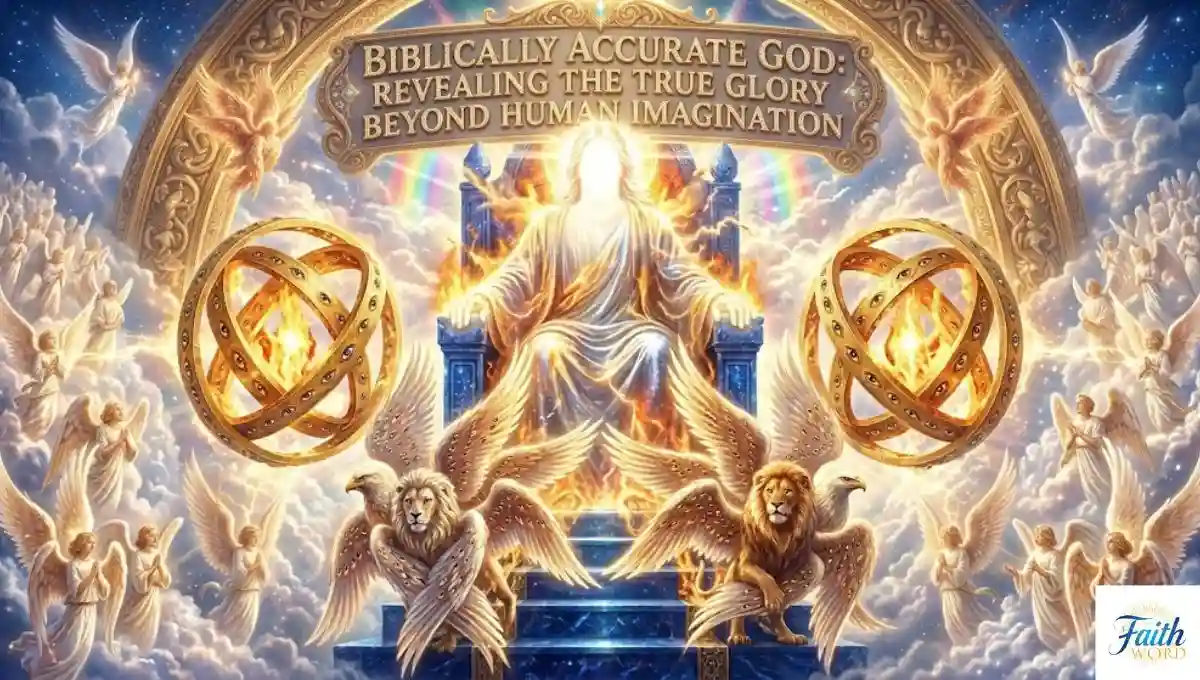
What if your understanding of God has been shaped more by culture than by Scripture? Many people hold a picture of God formed by tradition, media, or assumptions, yet the biblically accurate God is far greater than any human idea. To truly grasp the nature of God in the Bible, we must return to Scripture itself, where God’s character, His holiness, justice, mercy, and love are revealed with clarity and consistency.
The true nature of God is not defined by opinion but by His own divine self-disclosure, ultimately made complete in Jesus Christ as the full revelation of God. When we begin understanding God biblically and knowing God through Scripture, our perspective shifts—from confusion to clarity, from assumption to truth. This journey toward a biblical view of God not only corrects false ideas but leads to a deeper, more authentic, and transforming relationship with Him.
The Concept of a Biblically Accurate God
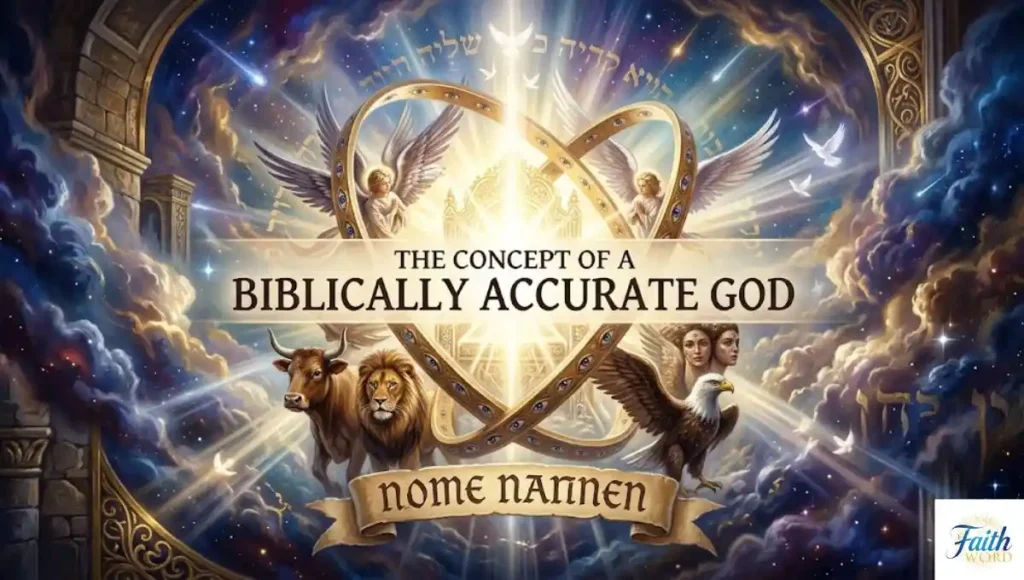
The phrase “biblically accurate God” might sound like a technical theological term, but its meaning is beautifully simple. It refers to understanding the biblically accurate God built exclusively on what Scripture reveals — not what tradition assumes, culture projects, or personal preference desires.
The biblically accurate God meaning centers on this commitment: allow the Bible, from Genesis to Revelation, to be the sole architect of your understanding of who God is. This concept goes beyond cultural symbols and religious habits. It is an invitation to encounter the living God on His own terms, through His own self-disclosure.
Why does this matter so much?
- A wrong view of God produces wrong worship.
- A wrong view of God leads to wrong decisions.
- A wrong view of God distorts your identity, your prayers, and your relationships.
- A wrong view of God makes authentic faith impossible.
Understanding who is God according to the Bible — meeting the biblically accurate God — is not an academic exercise reserved for theologians. It is the most practical and life-shaping pursuit any human being can undertake. The real meaning of God’s nature revealed in Scripture is the foundation upon which everything else in the Christian life is built.
When we pursue an accurate view of God, we are not merely gathering information about a distant being. We are opening ourselves to relationship with the One who created us, sustains us, redeems us, and will one day bring all things to completion.
Also Read : Discord Meaning in the Bible: Biblical Symbolism, Spiritual Warning & Hidden Faith Message
Core Divine Attributes Revealed in Scripture
Essential Divine Attributes
Scripture does not leave us guessing about God’s character. The Bible systematically and progressively reveals a God whose attributes exist in perfect, unified harmony. These are not separate or conflicting qualities. They are facets of a single, infinitely complex personality.
Here is a foundational overview of the core attributes that define the biblically accurate God in Christianity as revealed in Scripture:
| Divine Attribute | Definition | Key Bible Reference |
| Omnipotence | All-powerful; nothing is impossible | Job 42:2; Genesis 18:14 |
| Omniscience | All-knowing; knows end from beginning | Isaiah 46:10; Psalm 147:5 |
| Omnipresence | Present everywhere simultaneously | Psalm 139:7–10; Jeremiah 23:24 |
| Holiness | Perfectly set apart from all evil | Isaiah 6:3; 1 Peter 1:15–16 |
| Love | Volitional, sacrificial, eternal love | 1 John 4:8; John 3:16 |
| Justice | Perfect moral rightness and equity | Psalm 89:14; Deuteronomy 32:4 |
| Mercy | Compassion to the undeserving | Lamentations 3:22–23; Titus 3:5 |
| Faithfulness | Always keeps every promise | Lamentations 3:23; 2 Timothy 2:13 |
| Immutability | Never changes in character or purpose | Malachi 3:6; Hebrews 13:8 |
| Sovereignty | Absolute authority over all creation | Ephesians 1:11; Psalm 115:3 |
These are not abstract philosophical categories. They are living, revelatory truths about the God who spoke the universe into existence and who knows your name.
God’s Various Forms and Manifestations
One of the most fascinating dimensions of God’s presence and manifestation in Scripture is the variety of forms through which He reveals Himself across redemptive history:
- Burning bush (Exodus 3) — God’s holy presence that does not consume what it touches
- Pillar of cloud and fire (Exodus 13) — God’s guiding presence over His people
- Still small voice (1 Kings 19:12) — God’s intimate whisper to a broken prophet
- Consuming fire (Hebrews 12:29) — God’s absolute purity and intolerance of sin
- Shekinah glory (Exodus 40:34–35) — God’s visible glory filling the tabernacle
- Vision of the throne (Isaiah 6; Ezekiel 1) — God’s overwhelming, incomprehensible majesty
- The incarnate Jesus (John 1:14) — God’s most complete and personal self-disclosure
Each of these manifestations reveals a different facet of the same unchanging God.
Key Distinctions in Divine Manifestation
The most fundamental distinction in understanding the biblical description of God is this: God is spirit. Jesus declared it plainly in John 4:24 — “God is spirit, and those who worship him must worship in spirit and truth.” Spirit is His essential nature. He is not a physical being confined to a body. He is not limited by space, time, or matter.
This is why Israel was forbidden to create images of God. Any image imposes human limitations on an infinite being. It reduces the incomprehensible to the manageable. The difference between cultural God and biblical God often begins precisely here — at the question of form and nature. Culture wants a God it can picture and control. Scripture reveals a God whose essence transcends every human category of thought.
Biblical Descriptions of God’s Appearance

Prophetic Visions of Divine Glory
When prophets were granted glimpses of God’s glory, they struggled to find words adequate for what they witnessed. Their descriptions overflow with vivid imagery precisely because human language cannot contain divine reality.
Ezekiel’s Vision (Ezekiel 1:26–28): Above a vast expanse, Ezekiel saw what appeared to be a sapphire throne. On it was a figure resembling a man, surrounded by brilliant light and fire — glowing amber from the waist up, blazing fire from the waist down, with a radiant halo all around. Ezekiel described it as “the appearance of the likeness of the glory of the Lord.” Note the careful layering of metaphor: it was the appearance of a likeness of glory, not glory itself.
Isaiah’s Vision (Isaiah 6:1–5): Isaiah saw the Lord seated on a high and exalted throne, with the train of His robe filling the temple. Seraphim cried to one another: “Holy, holy, holy is the Lord Almighty; the whole earth is full of his glory.” Isaiah’s immediate response was terror: “Woe to me! I am ruined!”
John’s Vision (Revelation 1:14–16): John described the risen Christ with hair white as snow, eyes blazing like fire, feet like bronze in a furnace, and a voice like rushing waters. His face shone like the sun in full strength.
These descriptions are not meant to be literal photographs. They use rich, symbolic language to communicate the overwhelming, awe-inspiring nature of God’s glory in Scripture — the glory of the biblically accurate God — a glory that simultaneously draws and overwhelms every creature who encounters it.
Progressive Revelation of God’s Character
God’s self-revelation in Scripture did not happen all at once. Like a sunrise that begins with the faintest hint of light and builds to full noon brilliance, God progressively revealed Himself across thousands of years of redemptive history.
Stages of Divine Self-Disclosure
- Creation Era (Genesis 1–2): God reveals Himself as the all-powerful, all-wise Creator who brings order from chaos and breathes life into humanity. The primary truth: He is the sovereign Author of existence.
- Patriarchal Period (Genesis 12–50): God reveals Himself as a covenant-making, promise-keeping God. He binds Himself by oath to Abraham and his descendants. The primary truth: He is the God who calls and commits.
- Mosaic Era (Exodus–Deuteronomy): God reveals His holiness through the Law, His power through the plagues, and His presence through the tabernacle. The primary truth: He is holy and demands holiness from His people.
- Prophetic Age (Samuel through Malachi): God reveals His redemptive heart, His grief over sin, His patient pursuit of wandering people, and His ultimate plan of salvation. The primary truth: He is the God who disciplines and restores.
- Incarnation (The Gospels): God reveals Himself with ultimate clarity and completeness in the person of Jesus Christ. The primary truth: He is a God who enters into human suffering to rescue His people.
- New Covenant Age (Acts–Revelation): God reveals the full implications of the gospel and the indwelling of His Spirit in every believer. The primary truth: He is the God who dwells within and transforms from the inside out.
Experiencing the Presence of God in Everyday Life
Understanding the spiritually accurate God is not merely an intellectual achievement — it is a gateway into daily, tangible encounter. God does not confine His presence to Sunday mornings or formal religious settings. He saturates ordinary life for those who have eyes to see.
Here is where believers encounter God’s presence and manifestation in the rhythms of daily life:
- In Scripture reading — God speaks through His written Word. 2 Timothy 3:16 affirms all Scripture is God-breathed and profitable for teaching, correction, and training in righteousness.
- In prayer — God hears and responds to the cries of His people. Philippians 4:6–7 promises the peace of God that surpasses understanding as a fruit of prayer.
- In creation — Romans 1:20 declares that God’s invisible qualities — His eternal power and divine nature — are clearly seen through what has been made.
- In community — Matthew 18:20 records Jesus’ promise: “Where two or three gather in my name, there am I with them.”
- In suffering — Psalm 34:18 assures: “The Lord is close to the brokenhearted and saves those who are crushed in spirit.”
- In service — When believers love and serve others, they embody God’s presence in the world and encounter Him in the act of giving.
The key to experiencing the biblically accurate God daily — the God the Bible actually describes — is cultivating a Scripture-shaped sensitivity — learning to recognize the fingerprints of the God the Bible describes in the textures of ordinary life.
Jesus Christ: The Complete Revelation of God
Christ as the Perfect Image of God
If you want to know what the biblically accurate God looks like in His fullness, look at Jesus. This is not a devotional sentiment. It is the explicit claim of Scripture.
Colossians 1:15 declares Jesus to be “the image of the invisible God.” The Greek word used here is eikon — meaning exact representation, perfect correspondence. Not a sketch. Not a rough approximation. The fullness of who God is, expressed in human form.
Colossians 2:9 goes even further: “In Christ all the fullness of the Deity lives in bodily form.” Not a portion of divinity. Not a shadow of it. All of it. The true nature of God in the Bible — the fullness of the biblically accurate God — finds its most complete expression in Jesus of Nazareth.
Jesus as God’s Exact Representation
Hebrews 1:3 offers perhaps the most precise statement in all of Scripture about the relationship between Jesus and God: He is “the radiance of God’s glory and the exact representation of his being.” The word for “exact representation” (charakter in Greek) referred in ancient usage to the impression left by a seal — a perfect, unmistakable match.
When Jesus healed the sick, He was displaying God’s compassion. When He turned over the money-changers’ tables, He was displaying God’s holy intolerance of exploitation. When He wept at Lazarus’ tomb, He was displaying God’s deep engagement with human grief. Every action, every word, every relationship of Jesus was a living demonstration of the biblically accurate God as God revealed in the Bible in His most personal form.
Divine Attributes Displayed Through Jesus
Christ’s Demonstration of Divine Attributes
| Divine Attribute | Jesus’ Demonstration | Gospel Reference |
| Omnipotence | Calmed storms, raised the dead | Mark 4:39; John 11:43 |
| Omniscience | Knew hearts and thoughts | John 2:25; John 4:17–18 |
| Holiness | Lived without sin | Hebrews 4:15; 2 Corinthians 5:21 |
| Love | Died for sinners | Romans 5:8; John 15:13 |
| Justice | Confronted hypocrisy and corruption | Matthew 23; John 2:13–17 |
| Mercy | Forgave adulterers, tax collectors, thieves | John 8:11; Luke 19:9; Luke 23:43 |
| Faithfulness | Kept every promise He made | Luke 24:44; John 19:30 |
| Sovereignty | All authority in heaven and earth | Matthew 28:18 |
Jesus as the Key to Understanding Scripture
Christ as the Interpretive Lens
One of the hidden truths about God in Scripture is that the entire Bible is, at its core, a single unified story pointing to and flowing from Jesus Christ. Luke 24:27 records the risen Jesus walking with two disciples on the road to Emmaus, explaining how all Scripture from Moses through the Prophets pointed to Himself. John 5:39 records Jesus telling religious leaders: “You study the Scriptures diligently because you think that in them you have eternal life. These are the very Scriptures that testify about me.”
Reading the Bible without Christ at the center is like trying to read a map without knowing where the destination is. Jesus is the interpretive key. The Old Testament is preparation; the Gospels are revelation; the Epistles are explanation; and Revelation is consummation.
God’s Redemptive Work Through Christ
Christ’s Redemptive Accomplishments
The God’s redemptive plan in the Bible reaches its absolute climax in the cross and resurrection of Jesus Christ. Here is what Christ accomplished:
- Propitiation — The wrath of God against sin was fully satisfied (Romans 3:25). Justice was not set aside. It was fully executed — on Christ.
- Reconciliation — The broken relationship between holy God and sinful humanity was restored (2 Corinthians 5:18–19).
- Redemption — Believers were purchased out of slavery to sin at the cost of Christ’s blood (Ephesians 1:7).
- Justification — God legally declared believers righteous on the basis of Christ’s righteousness credited to them (Romans 5:1).
- Adoption — Believers were brought into God’s family as beloved children and co-heirs with Christ (Galatians 4:4–5; Ephesians 1:5).
These are not separate events. They are simultaneous, interconnected realities that together constitute what it means to be saved by the biblically accurate God.
Essential Characteristics of the Biblically Accurate God
Divine Omnipotence and Omniscience
How God’s Power and Knowledge Work Together
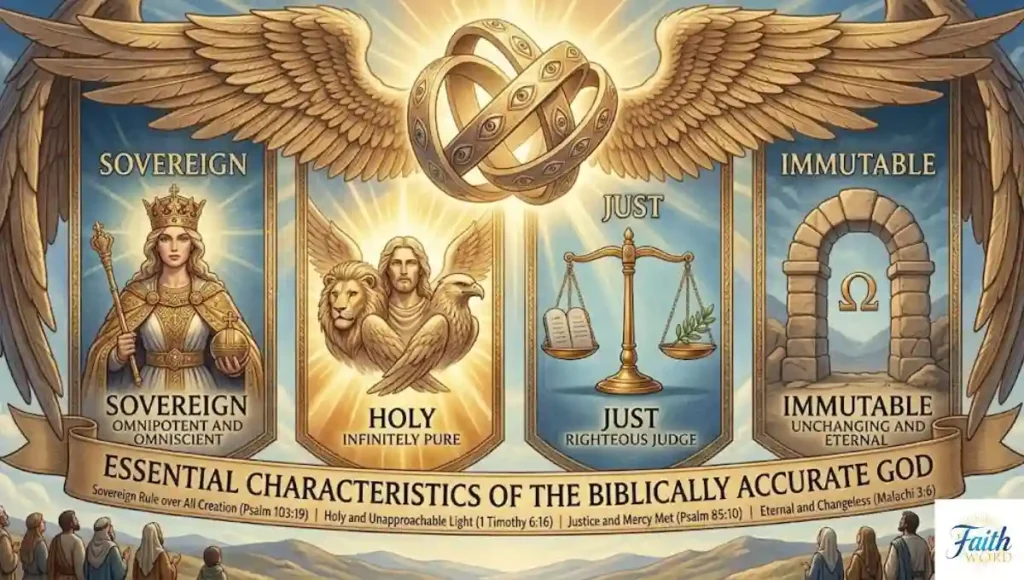
God’s omniscience, omnipotence, and omnipresence are not isolated attributes. They work together in perfect concert. His omnipotence means there is no situation beyond His ability to address. His omniscience means there is no situation of which He is unaware. And His omnipresence means there is no place where you are outside His reach.
Practically, these truths carry enormous weight:
- When you face an impossible situation, you are never beyond the reach of an all-powerful God.
- When you feel unseen and unknown, you are never hidden from an all-knowing God.
- When you feel utterly alone, you are never beyond the presence of an everywhere-present God.
Job 42:2 captures this perfectly: “I know that you can do all things; no purpose of yours can be thwarted.” That verse is not merely a theological statement. It is a declaration of confidence in a God whose power and knowledge are infinite and inseparable.
Perfect Holiness and Righteous Justice
The Relationship Between Holiness and Justice
When studying the biblically accurate God, the biblical meaning of God’s holiness is often misunderstood as cold severity. In reality, God’s holiness is the foundation of His moral perfection — His absolute separation from everything that is false, corrupt, or evil. It is what makes Him trustworthy. A God who was not holy could not be fully trusted.
God’s holiness and righteousness flow together into His justice. Because He is perfectly holy, He must respond to sin with righteous judgment. Habakkuk 1:13 declares that God cannot look on evil with approval. Hebrews 9:27 establishes that after death comes judgment.
But here is what makes the cross the most breathtaking moment in human history: at Calvary, God’s justice was not set aside — it was fully and finally executed. Sin received its full penalty. The difference is that the penalty fell on the willing substitute, Jesus Christ, rather than on the guilty sinner who deserved it.
The relationship between God’s holiness and justice:
- Holiness defines what is right.
- Justice ensures that what is right is upheld.
- Together they explain why the cross was necessary.
- Together they explain why salvation is such an astonishing gift.
Boundless Love and Abundant Mercy
Divine Love and Mercy in Action
Perhaps no single attribute of God is more frequently misrepresented than His love. Culture has reduced divine love to sentimental permissiveness — a warm affirmation that overlooks sin and demands nothing. The biblically accurate God reveals a love that is infinitely richer, more complex, more complex, and more demanding.
Biblical love is:
- Volitional — God chose to love before humanity did anything to deserve it (1 John 4:19).
- Sacrificial — God’s love was expressed in the most costly act in history (John 3:16; Romans 5:8).
- Purposeful — God’s love aims at transformation, not mere comfort (Romans 8:29).
- Eternal — Nothing can separate believers from God’s love in Christ (Romans 8:38–39).
God’s love and justice balance reaches its perfect expression at the cross. Love motivated God to send His Son. Justice demanded satisfaction for sin. Mercy extended forgiveness to the guilty. Grace provided righteousness to the undeserving. All four attributes were displayed simultaneously, perfectly, at one moment, at one place, to accomplish one eternal purpose.
The Eternal Nature of God: Unchanging Across Time and Creation
One of the most stabilizing truths about the biblically accurate God and the nature of God in Christianity is His absolute unchangingness. God does not evolve. He does not learn. He does not improve. He was not younger in Genesis and older in Revelation. He is the eternal I AM, the same yesterday, today, and forever.
Key Scripture declarations about God’s eternal nature and God’s unchanging character:
- Psalm 90:2 — “Before the mountains were born or you brought forth the whole world, from everlasting to everlasting you are God.”
- Malachi 3:6 — “I the Lord do not change. So you, the descendants of Jacob, are not destroyed.”
- Hebrews 13:8 — “Jesus Christ is the same yesterday and today and forever.”
- Revelation 1:8 — “I am the Alpha and the Omega,” says the Lord God, “who is, and who was, and who is to come, the Almighty.”
- Isaiah 46:9–10 — “I am God, and there is no other; I am God, and there is none like me. I make known the end from the beginning.”
This matters profoundly in practical life. The God who rescued Israel from Egypt is the same God who can rescue you from whatever enslaves you today. The God whose promises to Abraham were fulfilled is the same God whose promises to you in Christ will be fulfilled. God’s unchanging character is the bedrock of every prayer and every act of faith.
The Triune Nature of God: Father, Son, and Spirit

Biblical Foundation for the Trinity
Scriptural Evidence for Trinitarian Doctrine
Understanding the Trinity is central to knowing the biblically accurate God and to biblical theology of God. The word “Trinity” does not appear in Scripture, but the reality it describes is woven throughout both Testaments with remarkable consistency.
Key Trinitarian evidence across Scripture:
- Genesis 1:26 — God says “Let us make mankind in our image.” The plural pronoun points toward plurality within the Godhead.
- Deuteronomy 6:4 — “The Lord our God, the Lord is one.” The Hebrew word echad (one) allows for composite unity, as in one cluster of grapes.
- Isaiah 48:16 — “And now the Sovereign Lord has sent me, endowed with his Spirit.” Three distinct persons referenced in one verse.
- Matthew 3:16–17 — At Jesus’ baptism, the Spirit descends like a dove and the Father’s voice speaks from heaven while the Son stands in the water. All three persons are present and distinct simultaneously.
- Matthew 28:19 — Jesus commands baptism “in the name (singular) of the Father and of the Son and of the Holy Spirit.”
- 2 Corinthians 13:14 — “May the grace of the Lord Jesus Christ, and the love of God, and the fellowship of the Holy Spirit be with you all.”
The doctrine of the Trinity means that there is one God who eternally exists as three distinct Persons — the Father, the Son, and the Holy Spirit. Each Person is fully God. There are not three gods. There is one God in three Persons.
God the Father’s Role
The Father’s Work in Redemption
The Father is the initiating Person within the eternal divine fellowship of the biblically accurate God. His role in redemption is characterized by sovereign love, holy purpose, and gracious adoption:
- Election — Choose believers in Christ before the foundation of the world for holiness (Ephesians 1:4).
- Sending — Sent the Son into the world out of love (John 3:16; Galatians 4:4).
- Adoption — Romans 8:15 explains the Spirit of adoption enables crying “Abba, Father,” a term conveying both respect and deep affection.
- Providence — Governs all things according to the counsel of His will (Ephesians 1:11).
- Discipline — Hebrews 12:6 assures that the Father disciplines every son He loves.
God the Son’s Work
Christ’s Divine and Mediatorial Functions
Jesus Christ, the eternal Son, took on human nature to accomplish redemption while fully maintaining His divine essence. Philippians 2:6–8 describes His voluntary humiliation — existing in the form of God yet taking the form of a servant, being made in human likeness, obedient to death on a cross.
The Son’s key functions:
- Incarnation — God took on human flesh to dwell among us (John 1:14).
- Active Obedience — Jesus fulfilled every demand of the Law perfectly throughout His life (Matthew 5:17).
- Atoning Death — He died as a substitute, bearing the penalty of sin for all who believe (2 Corinthians 5:21).
- Resurrection — He rose bodily from the dead, conquering sin and death (1 Corinthians 15:3–4).
- Intercession — He now mediates at the right hand of the Father for all believers (Hebrews 7:25; Romans 8:34).
God the Holy Spirit’s Ministry
The Spirit’s Multifaceted Work
The Holy Spirit is the least-understood member of the Trinity but absolutely essential to every aspect of the Christian life. His ministry is comprehensive, personal, and powerful:
- Conviction — Convicts the world of sin, righteousness, and judgment (John 16:8).
- Regeneration — Gives new spiritual life at conversion (Titus 3:5; John 3:5).
- Indwelling — Permanently takes up residence within every believer (1 Corinthians 6:19).
- Illumination — Opens the human mind to understand and apply Scripture (1 Corinthians 2:14).
- Sanctification — Progressively transforms believers toward Christlikeness (Galatians 5:22–23; 2 Thessalonians 2:13).
- Intercession — Prays through believers when they cannot find words (Romans 8:26–27).
- Empowerment — Equips believers for witness, service, and ministry (Acts 1:8).
The Relational Character of God
Implications of God’s Triune Nature
The Trinity reveals something breathtaking about God’s character in Scripture: love, fellowship, and relationship are not qualities God acquired when He created people. They exist within God’s very being, eternally, as Father, Son, and Spirit dwell in perfect, joyful communion.
John 17:24 reveals that the Father has loved the Son before the foundation of the world. God has always been, in His own eternal nature, a community of love. He did not need to create humanity to experience relationships. He created out of overflowing love, inviting creatures to share in the divine fellowship that has always existed within the Godhead.
For believers, this means: when you are welcomed into a relationship with God, you are being invited into a fellowship that is older than the universe itself.
Correcting Common Misconceptions About God
Why Distorted Views of God Develop
Sources of Theological Distortion
What most people get wrong about God almost always traces back to one of four sources:
- Personal wounding — Those who experienced abusive, absent, or demanding authority figures often unconsciously project those qualities onto God. A harsh earthly father produces an image of a demanding, impossible-to-please heavenly Father.
- Cultural conditioning — Different cultures emphasize different values. Cultures that prize tolerance and acceptance tend to produce a God who never judges. Cultures that prize moral order tend to produce a God who never forgives.
- Selective Bible reading — Focusing exclusively on verses about love while ignoring verses about holiness, or vice versa, produces a lopsided and ultimately false portrait of God.
- Inadequate teaching — Churches that present an incomplete picture of God, favoring certain attributes while neglecting others, produce theologically malnourished believers who lack the full counsel of Scripture.
False Images That Misrepresent God
Common Distortions of God’s Character
| False Image of God | Core Claim | Biblical Correction |
| The Angry Tyrant | God is harsh, impossible to satisfy | 1 John 4:8; Romans 8:1 |
| The Indulgent Grandfather | God overlooks all sin lovingly | Hebrews 12:29; Nahum 1:3 |
| The Detached Watchmaker | God created and stepped back | Matthew 10:29–31; Colossians 1:17 |
| The Tribal Deity | God favors only one group | Acts 10:34–35; Galatians 3:28 |
| The Cosmic Therapist | God’s purpose is to make you feel good | Isaiah 46:9; Romans 11:36 |
| The Permissive Friend | God agrees with whatever you decide | Proverbs 14:12; Isaiah 55:8–9 |
How Scripture Corrects Our Understanding
Process for Correcting Misconceptions
The good news is that distorted views of the biblically accurate God are correctable. Scripture provides both the diagnosis and the cure. 2 Timothy 3:16–17 establishes that all Scripture is God-breathed and useful for “correction and training in righteousness.”
The process for correcting misconceptions involves:
- Recognize the distortion — Honestly identify where your picture of God diverges from Scripture.
- Trace the source — Understand whether the distortion comes from personal experience, culture, selective reading, or poor teaching.
- Submit to the full counsel of Scripture — Study God’s character comprehensively, not selectively.
- Invite the Spirit’s illumination — John 16:13 promises the Spirit of truth guides into all truth.
- Find accountability in community — Allow mature believers and sound teaching to challenge and shape your understanding.
- Practice transformed thinking — Apply the corrected understanding consistently in prayer, worship, and daily decisions.
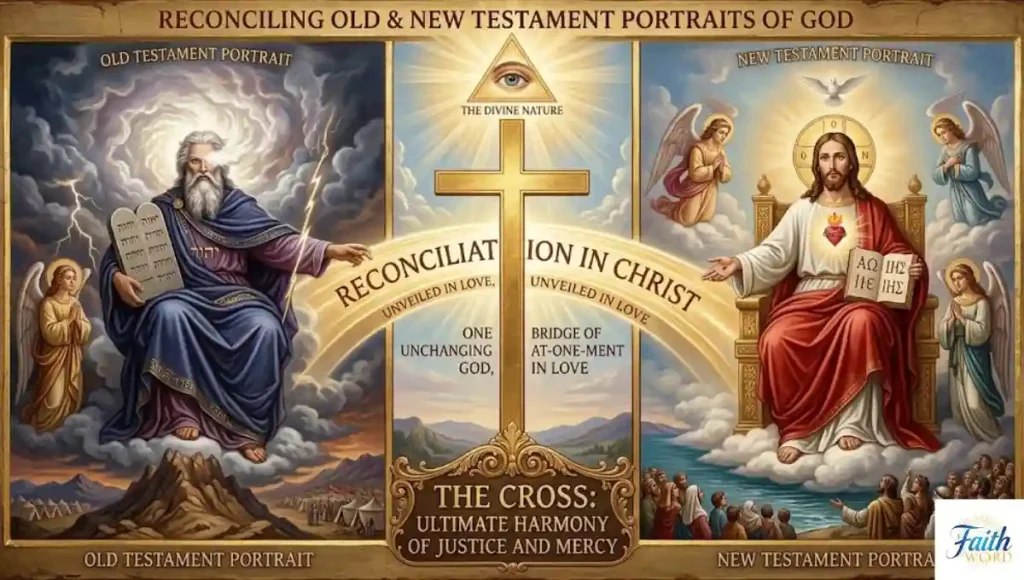
Reconciling Old and New Testament Portraits of God
Progressive Revelation Explained
Understanding Development in Divine Disclosure
One of the most frequently asked questions about the biblically accurate God — and about biblical interpretation of God’s nature — is this: Is the God of the Old Testament different from the God of the New Testament? The Old Testament God seems to command violence and judge severely. The New Testament God seems loving and forgiving. Are these actually the same God?
The answer requires understanding progressive revelation of God — the theological principle that God’s self-disclosure developed across time, building from partial to full, from shadows to substance, from types to antitype.
God did not change. His disclosure became increasingly clear and complete. Think of it this way: a photograph that gradually develops in a darkroom does not change its subject — it simply reveals more of the same person with increasing clarity.
God’s Consistent Character Throughout Scripture
Divine Attributes Across Both Testaments
| Attribute | Old Testament | New Testament |
| Love | Hosea 11:1; Jeremiah 31:3 | John 3:16; Romans 5:8 |
| Justice | Deuteronomy 32:4; Amos 5:24 | Romans 3:26; 2 Thessalonians 1:6 |
| Mercy | Psalm 103:8; Micah 7:18 | Titus 3:5; Ephesians 2:4 |
| Holiness | Leviticus 19:2; Isaiah 6:3 | 1 Peter 1:15–16; Revelation 4:8 |
| Faithfulness | Lamentations 3:23; Psalm 36:5 | 2 Timothy 2:13; 1 Corinthians 1:9 |
| Wrath against sin | Genesis 6–7; Nahum 1:2 | John 3:36; Romans 1:18 |
The same attributes appear in both Testaments because it is the same God in both Testaments.
Divine Judgment Across Both Testaments
Continuity of Divine Justice
One common error is assuming that judgment belongs exclusively to the Old Testament. In reality, God’s covenant relationship with humanity throughout both Testaments involves the same holy God responding consistently and justly to sin.
- In the Old Testament: God judges Sodom and Gomorrah, the nations of Canaan, and repeatedly disciplines rebellious Israel.
- In the New Testament: Romans 1 describes God’s ongoing judgment on human wickedness. Hebrews 9:27 establishes that all people face judgment after death. Revelation depicts the final, comprehensive judgment of all unrighteousness.
The difference is not that the New Testament God is less just. The difference is that in Christ, God provided a way for guilty sinners to receive justice on their behalf through a willing substitute, rather than personally bearing the full weight of divine judgment.
Christ’s Interpretation of Difficult Passages
Jesus’ Hermeneutical Approach
When encountering difficult Old Testament passages about violence, judgment, or divine commands that seem harsh, Jesus provides the interpretive model. He consistently interpreted challenging texts in light of God’s ultimate redemptive purpose. He showed that God’s responses to sin in the Old Testament — however dramatic they appear — flow from the same holy, loving character that drove God to send His Son to die for sinners.
In Matthew 5, Jesus repeatedly used the formula “You have heard it said… but I tell you” — not to contradict the Old Testament, but to fulfill and deepen its meaning by revealing the heart behind the command.
Unity of God’s Redemptive Plan
Consistent Redemptive Thread
The entire Bible is one unified story of God’s redemptive plan in the Bible, with a single consistent purpose:
- Promise (Genesis 3:15) — God promises a Redeemer to crush the serpent’s head.
- Pattern (Exodus 12) — The Passover lamb foreshadows Christ, the Lamb of God.
- Prophecy (Isaiah 53) — The Suffering Servant gives His life as a guilt offering.
- Fulfillment (Matthew–John) — Jesus accomplishes what every type and prophecy pointed toward.
- Explanation (Acts–Jude) — The apostles unfold the meaning and implications of Christ’s work.
- Consummation (Revelation) — All things are brought to completion under the sovereign reign of God.
Common Misinterpretations Regarding God’s Nature
Balancing Divine Love and Justice
How Love and Justice Coexist
The most persistent theological misinterpretation about understanding God’s nature is the assumption that love and justice are opposites that must be balanced against each other — as if showing love requires sacrificing justice, and showing justice requires withholding love.
The God’s love and justice balance in Scripture reveals something far more beautiful. At the cross, both attributes were expressed simultaneously and completely. Romans 3:25–26 explains that God presented Christ as an atoning sacrifice “to demonstrate his righteousness” so that “he might be just and the one who justifies those who have faith in Jesus.” Justice was not compromised. Love was not diluted. Both were fully and simultaneously expressed.
How love and justice coexist in God:
- Love without justice produces a God whose promises cannot be trusted — because He cannot be relied upon to uphold what is right.
- Justice without love produces a God who is unapproachable — because no sinner can survive His perfect standard.
- Love and justice together produce a God who can be both fully trusted and fully embraced — because He upholds what is right while offering what is needed to the guilty.
Understanding Sovereignty and Human Responsibility
The Paradox of Divine Control and Human Choice
God’s sovereignty and human responsibility represent one of the most discussed paradoxes in the Christian doctrine of God. Both truths are clearly taught in Scripture. Neither can be reduced to the other.
- God is absolutely sovereign — He works all things according to the counsel of His will (Ephesians 1:11). His purposes cannot be thwarted (Job 42:2).
- Human beings are genuinely responsible — They make real choices with real consequences (Deuteronomy 30:19; Joshua 24:15).
- Both are true simultaneously — Joseph’s brothers sold him into slavery with evil intent; God used the same event to accomplish His redemptive purpose (Genesis 50:20).
Scripture does not resolve this paradox by explaining the mechanism. It simply affirms both truths and invites believers to trust in a God whose ways are infinitely higher than human reasoning (Isaiah 55:8–9).
Why Biblical Accuracy Matters in Understanding God

Knowing God as He Truly Is
Scripture as the Sole Reliable Source
Why accurate theology matters in Christianity cannot be overstated. The quality of your faith is directly proportional to the accuracy of your understanding of who God is. A wrong God produces wrong worship. Wrong worship produces wrong living. Wrong living produces a life that is fundamentally out of alignment with reality.
Scripture alone provides reliable access to the biblically accurate God through God’s self-revelation in Scripture. Every other source — tradition, experience, reason, culture — must be evaluated and corrected by the written Word of God. 2 Timothy 3:16–17 declares: “All Scripture is God-breathed and is useful for teaching, rebuking, correcting and training in righteousness, so that the servant of God may be thoroughly equipped for every good work.”
Guiding Faith and Daily Decisions
Practical Impact of Accurate Theology
Knowing the biblically accurate God reshapes every dimension of practical daily life. This is the most practical reason why studying the biblically accurate God matters:
- In suffering — Trust in a sovereign, omniscient God who works all things together for good (Romans 8:28).
- In temptation — Rely on a holy God who provides a way of escape (1 Corinthians 10:13).
- In decision-making — Seek wisdom from an omniscient God who gives generously to those who ask (James 1:5).
- In relationships — Reflect the image of a loving, just, merciful God in how you treat others.
- In failure — Return to a gracious, forgiving God who does not condemn those who are in Christ (Romans 8:1).
Building Authentic Personal Relationship
Intimacy Grounded in Truth
How to build a relationship with God biblically requires beginning with knowing who He actually is. Relationships built on false images of God inevitably disappoint and eventually collapse. When you construct a God who exists to fulfill your expectations, He will always fall short — because you are not relating to the real God but to your own projection.
Intimacy with the real God grows through:
- Engaging His Word with honesty and humility.
- Bringing your full, unfiltered self to Him in prayer.
- Allowing His character, as revealed in Scripture, to reshape your expectations.
- Worshiping Him for who He is, not merely for what He provides.
Countering False Representations
Correcting Theological Distortions
The difference between cultural God and biblical God has never mattered more than in the present moment. Popular culture saturates people with images of God designed to affirm, entertain, and comfort rather than to reveal truth. The biblically accurate God will sometimes challenge, confront, and discomfort — because He is real, and reality is sometimes hard.
Countering theological distortions requires:
- Prioritizing Scripture over sentiment in forming your understanding of God.
- Being willing to revise your mental picture of God when it conflicts with clear biblical teaching.
- Engaging in communities where God’s full character — including His holiness, justice, and wrath — is taught alongside His love, grace, and mercy.
Life Transformation Through Knowing God’s True Nature
From Fear to Confident Assurance
Replacing Dread with Bold Access
One of the most dramatic life changes that comes from truly knowing the biblically accurate God is the replacement of religious dread with confident, joyful assurance. Many people live under the suffocating weight of a God they can never satisfy, who is always disappointed, and from whose presence they want to hide.
Scripture offers a radically different invitation. Hebrews 4:16 declares: “Let us then approach God’s throne of grace with confidence, so that we may receive mercy and find grace to help us in our time of need.” This bold access is not earned. It is gifted through Christ’s perfect mediation.
From Religious Performance to Grace-Based Rest
Shifting from Striving to Receiving
When your theology shifts from a demanding, never-satisfied God to the God revealed in the Bible — whose love is unconditional, whose acceptance is based on Christ’s merit rather than your performance — everything about the texture of your spiritual life changes.
You stop performing for approval you already have. You stop striving to earn what has already been freely given. You begin receiving what God offers rather than exhausting yourself trying to manufacture what only He can provide.
Worship Marked by Reverence and Intimacy
Balanced Worship Characteristics
Authentic worship of the biblically accurate God — the God the Bible actually describes — is always marked by two simultaneous qualities that might seem contradictory but are perfectly harmonious in light of who God is:
- Reverence — Awe at His infinite holiness, sovereignty, and transcendence. Isaiah’s response to God’s glory was to fall on his face. Healthy worship includes a deep sense of one’s own smallness before an incomprehensible God.
- Intimacy — Closeness made possible through Christ’s mediation and the Spirit’s indwelling. Romans 8:15 describes believers crying “Abba, Father” — a term of warm, familial affection.
- Gratitude — Thanksgiving for the staggering, undeserved grace that makes the previous two things simultaneously possible.
- Surrender — The willingness to yield your preferences, plans, and comfort to the purposes of a God whose wisdom infinitely exceeds your own.
Prayer Grounded in Trust
Confidence in God’s Character
Prayer is not a transaction with an unpredictable deity. It is a conversation with a fully known Father whose character is absolutely reliable. When you know that God is omniscient, omnipotent, perfectly loving, perfectly just, and eternally faithful, prayer becomes less about persuading God and more about aligning yourself with a God who already knows, already cares, and already governs wisely.
Philippians 4:6–7 promises that presenting your requests to God with thanksgiving results in a peace that surpasses all understanding. That promise stands because the God to whom you pray is trustworthy in ways that exceed your ability to comprehend.
Living with Divine Purpose and Hope
Transformational Outcomes
Knowing the God’s true nature in Christianity produces tangible, measurable transformation in every area of life:
- Stable identity — You know you are unconditionally loved and eternally secure, not because of your performance but because of God’s unchanging character.
- Clear purpose — You live for the glory of the God who created you, rather than the approval of people who are as finite as you are.
- Enduring hope — Your hope is anchored in the faithfulness of an unchanging God, not in the unpredictable circumstances of life.
- Contagious peace — The peace of God that surpasses understanding becomes a defining feature of your life in ways that draw others toward the God you have come to know.
Practical Steps to Learn About the Biblically Accurate God

Systematic Study of Biblical Texts
Organized Approach to Studying God’s Attributes
How to study God’s character in the Bible and know the biblically accurate God requires more than casual, random reading. It demands intentional, systematic engagement. Here is a practical approach:
- Choose one attribute and trace it through all of Scripture. For example, spend a month studying God’s faithfulness — from Genesis through Revelation — noting every passage where it appears.
- Study books that emphasize God’s nature: The Psalms are perhaps the richest source of devotional theology about God’s character. Isaiah provides the most majestic prophetic vision of God. Romans offers the most systematic theological exposition of God’s justice, mercy, and love.
- Use study tools: A quality concordance allows you to find every occurrence of words like “holy,” “mercy,” or “faithful” throughout Scripture. Commentary series by trusted scholars provide historical and literary context.
- Always test human interpretations against Scripture. Commentaries and systematic theologies are valuable servants of Scripture, not its masters.
- Keep a journal of what you discover about God. Writing deepens retention and invites reflection.
Seeking Divine Guidance Through Prayer
Prayer Practices for Deeper Understanding
Study without prayer produces cold intellectualism. The Spirit is not merely a theological concept — He is the living Teacher who illuminates Scripture from within. The biblically accurate God is best known when we approach Him not merely academically but devotionally.
Practical prayer disciplines for knowing the biblically accurate God more deeply:
- Pray Psalm 119:18 before reading: “Open my eyes that I may see wonderful things in your law.”
- Meditate on attributes discovered in reading — sit quietly with what you have found and allow it to work deeply into your understanding.
- Worship God specifically for what you have just learned about His character.
- Confess areas where your view of God has been distorted and ask Him to correct your understanding.
- Request personal transformation in response to each truth encountered. James 1:22 commands: “Do not merely listen to the word, and so deceive yourselves. Do what it says.”
Community and Fellowship’s Vital Role
Maximizing Communal Learning
Isolation is one of the most reliable paths to theological distortion. Private Bible study, conducted without the corrective influence of community, is vulnerable to our own blindspots, biases, and wishful thinking. God, the biblically accurate God, designed the body of Christ to function as a mutually correcting, mutually encouraging community of truth-seekers.
Practical steps for communal theological growth:
- Sit under qualified biblical teaching regularly. Find a church where the pastor preaches expositionally through Scripture, allowing the text to set the agenda rather than contemporary relevance or personal preference.
- Participate in a small group that studies Scripture together. Collaborative discussion surfaces insights that individual study often misses.
- Read widely among trusted theological authors across different centuries and traditions. C.S. Lewis, A.W. Tozer, J.I. Packer, and John Stott all wrote accessibly and profoundly about the nature and character of God.
- Invite accountability — find a mature believer who can challenge your thinking and hold you to rigorous engagement with Scripture.
Frequently Asked Questions
What does “biblically accurate God” mean, and why does it matter?
It means understanding God exclusively through Scripture rather than cultural assumptions, personal preferences, or religious traditions, because wrong views of God produce wrong worship and wrong living.
Is the God of the Old Testament the same as the God of the New Testament?
Yes — God’s character is perfectly consistent across both Testaments; only the progressive clarity of His self-disclosure increases as redemptive history unfolds toward Christ.
How does Jesus reveal the true nature of God according to Scripture?
Colossians 2:9 states that all the fullness of the Deity lives bodily in Christ, making Jesus the most complete, personal, and exact representation of the biblically accurate God in human history.
Can a person truly know God personally, or only know information about Him?
Scripture teaches both — God can be genuinely and personally known through Jesus Christ and the indwelling Holy Spirit, not merely studied as a theological subject (John 17:3).
How do I begin building a relationship with God based on biblical accuracy?
Begin by studying Scripture systematically, praying for the Spirit’s illumination, finding a sound teaching community, and allowing what you discover about God’s true character to reshape your prayers, worship, and daily decisions.
What role does the Holy Spirit play in knowing God?
The Holy Spirit helps believers understand Scripture, reveals God’s truth, and enables a deeper personal relationship with Him by dwelling within them.
Why is it important to study the whole Bible to understand God?
Because God reveals Himself progressively throughout all of Scripture, studying the entire Bible provides a fuller, balanced understanding of His character, purposes, and plan.
Can human reasoning alone fully comprehend God?
No — while reason can point toward God’s existence, His full nature and character are ultimately revealed through Scripture and require spiritual insight beyond human understanding.
Conclusion
The biblically accurate God is infinitely greater, more loving, more just, and more personally engaged than any cultural portrait or human imagination has ever captured. Pursuing an accurate view of God through careful, prayerful Scripture study is not dry theology — it is the most transforming pursuit available to any human being.
Understanding the true nature of God in the Bible reshapes your identity, your purpose, your worship, and your hope in ways nothing else can produce. Open your Bible, invite the Holy Spirit to illuminate its truth, and begin the lifelong journey of knowing the God who has been faithfully revealing Himself from the very first word of Scripture to the last.

Welcome to Thefaithword! I’m Abdul Mannan Haider. Christian Faith Writer | 10+ Years Bible Study Experience | Founder of (thefaithword.com)
Sharing prayers, blessings, and biblical wisdom to strengthen your faith.