

The subtil meaning in the Bible refers to understanding how God communicates through hidden messages in Scripture, often in quiet and subtle ways that require spiritual discernment and awareness. The biblical meaning of subtil reveals that God’s hidden messages in the Bible are not always loud or obvious but are revealed through spiritual insight, divine communication, and recognition of God’s guidance in everyday life.
Many believers seek to understand subtle messages from God, especially when reading Scripture or experiencing moments of spiritual reflection. Through Bible interpretation of subtil meaning, we learn that God speaking quietly in the Bible often involves the Holy Spirit leading and conviction, guiding believers toward truth. This concept encourages deeper faith, spiritual sensitivity, and a stronger connection to God’s whispers in daily life, helping us recognize hidden meaning in the Bible and grow in spiritual understanding.
Before we dive in — what every believer needs to know about the subtil meaning:
- The word “subtil” is the archaic KJV spelling of the modern word “subtle” — same pronunciation, stronger biblical connotation
- In eight out of the ten times the word subtil is used in the King James Version, it carries a negative connotation — linked to trickery, deception, and spiritual danger
- Only two uses carry a genuinely positive meaning: Proverbs 1:4 (godly discretion) and in the spirit behind Matthew 10:16 (wise as serpents)
- The subtil meaning operates on a double edge — it describes both the enemy’s most effective weapon and the believer’s highest calling in spiritual awareness
- Understanding the subtil meaning is not optional for spiritually mature Christians — it is foundational to discernment, faith protection, and walking in God’s wisdom
See More : Refuge Meaning in the Bible: Finding Safety in God’s Presence
What Does “Subtil” Mean in the Bible?
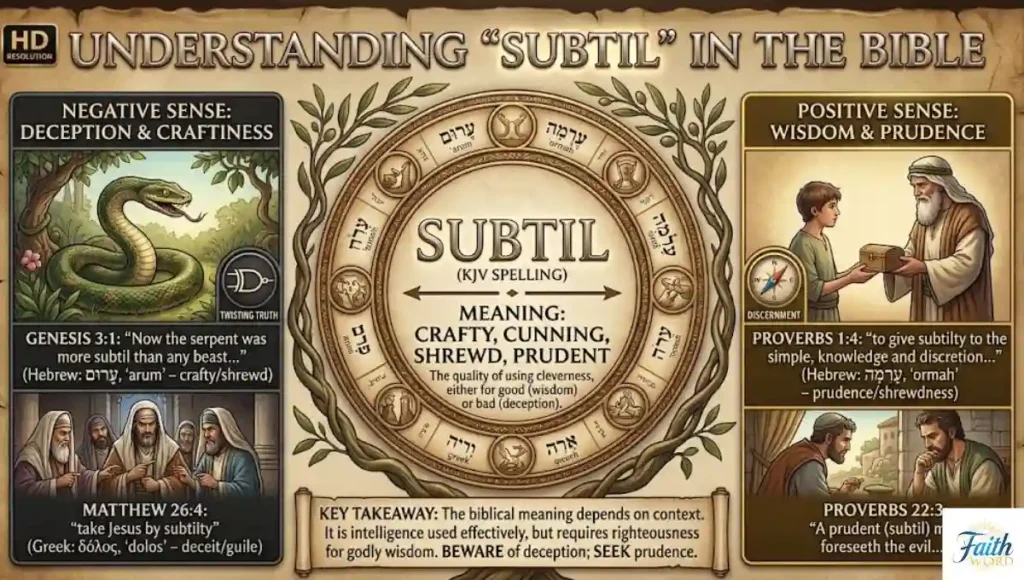
The subtil meaning in the Bible begins with its most basic definition. According to Webster’s American Dictionary of 1828 — the dictionary closest to the KJV’s original vocabulary — subtil means “thin, not dense or gross” and “cunning or artfulness.” In KJV biblical context, subtil does not mean soft, quiet, or easily overlooked. It means clever in a concealed way — scheming intelligence, not softness or humility.
The subtil meaning in the KJV carries a moral dimension that the modern word “subtle” has largely lost. In Scripture, subtil almost always signals a hidden agenda — an intelligence that moves beneath the surface, working through gentle words, carefully framed questions, and plausible-sounding reasoning to accomplish something that plain force could never achieve.
Key dimensions of the subtil meaning in biblical context:
- Cognitive — referring to unusual intelligence, perception, or cleverness
- Moral — almost always connected to a hidden agenda or deceptive intent
- Spiritual — pointing to either godly discernment or dangerous cunning, depending on context
- Relational — operating through conversation, influence, and persuasion rather than direct force
- Directional — the subtil meaning is never neutral; it is always moving toward either wisdom or destruction
“The Serpent Was Subtil” Biblical Meaning Explained
The most famous use of the subtil meaning in the entire Bible is Genesis 3:1: “Now the serpent was more subtil than any beast of the field which the Lord God had made.”
This verse is the entry point to understanding everything that follows. The serpent did not approach Eve with threats, violence, or obvious evil. It came with a question. A gentle, seemingly reasonable question: “Yea, hath God said, Ye shall not eat of every tree of the garden?” The subtil meaning here is this: the serpent’s danger was not in its fangs but in its words. It was more cunning than any other creature — and it used that cunning not to destroy directly but to introduce doubt, reframe truth, and guide Eve into a decision she never would have made if God’s word had stayed unchallenged in her heart.
The subtil meaning of Genesis 3:1 teaches believers six unchanging lessons:
- The enemy does not always roar — sometimes he questions
- Deception disguised as reasonable inquiry is the oldest spiritual strategy in history
- The subtil enemy targets the mind before the body — plant doubt first, then harvest sin
- Even accurately quoted Scripture can be twisted by subtil framing (the serpent did not lie outright — he reframed)
- The most vulnerable moment for subtil attack is a season of comfort, trust, and spiritual ease
- The only defense against subtil deception is a heart so saturated with God’s Word that the twist is immediately recognizable
Subtil Definition in the Bible (KJV)
The subtil meaning in the KJV covers at least eight distinct Hebrew words translated as “subtil,” each carrying its own shade of meaning. Here is the complete biblical lexicon of subtilty:
| KJV Hebrew Word | Transliteration | Core Meaning | Bible Reference |
| עָרוּם | Arum (H6175) | Crafty, cunning, clever | Genesis 3:1 |
| עָרְמָה | Ormah | Prudence, discretion, godly wisdom | Proverbs 1:4 |
| מִרְמָה | Mirmah | Deceit, fraud, guile | Genesis 27:35 |
| נָכַל | Nakal | To trick, to deceive | Psalm 105:25 |
| נָצַר | Natsar | To watch, guard, hidden intentions | Proverbs 7:10 |
| חָכָם | Chakham | Wise, clever, skilled | 2 Samuel 13:3 |
| λεπτός | Leptos (Greek) | Thin, refined, fine | Wisdom of Solomon 7:22 |
| στροφή | Strophe (Greek) | Winding, twisted speech | Ecclesiasticus 8:8 |
The subtil meaning across this lexicon reveals an important pattern: the same underlying quality — sharp, hidden, intelligent — can be directed toward God’s purposes (Proverbs 1:4) or toward sin and destruction (Genesis 3:1, Genesis 27:35). The quality itself is morally neutral. Its destination determines whether it becomes wisdom or wickedness.
Subtil vs Subtle Biblical Difference
The subtil meaning in the KJV and the modern word “subtle” share pronunciation but diverge significantly in connotation. Understanding the difference matters for accurate biblical interpretation.
Subtil (KJV):
- Archaic spelling used exclusively in the King James Version
- Carries a stronger, darker moral weight — almost always linked to cunning with a hidden sinful agenda
- Used in the context of spiritual deception, scheming behavior, and dangerous intelligence
- Derived from Latin subtilis — meaning fine, thin, delicate; in KJV theological context, something that operates beneath detection
Subtle (Modern English):
- Contemporary spelling; used across all modern Bible translations
- More neutral in common usage — can describe anything from a quiet flavor to a barely visible color difference
- Has lost much of the moral weight that the KJV subtil carried
- Modern translations often replace subtil with “crafty,” “cunning,” “shrewd,” or “wise”
The subtil meaning in biblical study is therefore always richer and more morally loaded than its modern equivalent suggests. When you read “subtil” in the KJV, think deliberate, calculating intelligence — not gentle barely-noticeable softness.
Subtil Meaning in Hebrew
The Hebrew foundation of the subtil meaning begins with the word arum (עָרוּם, Strong’s H6175), which the KJV translates as subtil in Genesis 3:1. The KJV translates Strong’s H6175 in the following manner: prudent (8 times), crafty (2 times), subtil (1 time).
This frequency distribution is revealing for the subtil meaning study:
- The word arum is most commonly translated as “prudent” — meaning the quality itself is predominantly positive in the Old Testament
- It appears as “crafty” only twice — both in negative moral contexts
- It appears as “subtil” once — in Genesis 3:1, the most negatively charged use in all of Scripture
A striking Hebrew wordplay around the subtil meaning in Genesis: The Hebrew word arum (subtil/crafty — H6175) used to describe the serpent in Genesis 3:1 is a deliberate wordplay against arummim (naked — H6174) used to describe Adam and Eve in Genesis 2:25. The serpent was arum — cunning. The humans were arummim — naked and vulnerable. The subtil meaning in Hebrew encoding alerts the reader before the story unfolds: a clothed cunningness is approaching the unguarded innocence. It is one of the most sophisticated literary warnings in the entire Bible.
Other Hebrew words carrying the subtil meaning:
- Ormah (Proverbs 1:4) — positive prudence and godly discretion; wisdom that protects the naive
- Mirmah (Genesis 27:35) — outright deceit and fraud; Jacob’s disguise before Isaac
- Nakal (Psalm 105:25) — Egypt dealing treacherously with God’s people
- Natsar (Proverbs 7:10) — the harlot with a “subtil heart” — hidden, guarded intentions
Subtil Meaning in Greek (Biblical Context)
The subtil meaning extends into the Greek New Testament and Apocrypha through two primary words:
- Leptos (λεπτός) — meaning thin, refined, or fine; used in the Wisdom of Solomon 7:22 to describe the spirit of wisdom as “subtil” — refined beyond ordinary perception, almost imperceptible in its operation, yet immensely powerful
- Strophe (στροφή) — meaning winding or twisted; used in Ecclesiasticus 8:8 for “subtilties of speeches” — language that winds through truth rather than traveling straight, arriving at a destination far from where it appeared to begin
The subtil meaning in Greek reveals the New Testament’s continued awareness of this dual spiritual dynamic: a refined, God-given discernment that perceives what others miss (leptos) versus a twisted, winding speech that deceives through complexity rather than directness (strophe). Both the gift and the danger are present in the Greek vocabulary of subtilty.
Subtilty Meaning in the Bible
While “subtil” is the adjective, “subtilty” is the noun form — and it carries the subtil meaning into observable behavior patterns. The word subtilty in the Bible describes the active use of subtil qualities: the practice of cunning, the deployment of crafty intelligence, the lived-out expression of hidden agendas.
Key Bible references for subtilty meaning:
- Genesis 27:35 — “Thy brother came with subtilty, and hath taken away thy blessing.” Jacob used mirmah (deceit) to obtain his father’s blessing — a clear negative use of subtilty
- 2 Kings 10:19 — “But Jehu did it in subtilty, to the intent that he might destroy the worshippers of Baal.” Here subtilty is used for a righteous end — strategic concealment in service of God’s judgment
- Matthew 26:4 — The chief priests and elders “consulted that they might take Jesus by subtilty” — subtilty in service of murderous intent
- Acts 13:10 — Paul confronts Elymas the sorcerer as “full of all subtilty and all mischief” — the fullest expression of the negative subtil meaning
- 2 Corinthians 11:3 — Paul warns the Corinthians as Eve was deceived “through his subtilty” — the serpent’s pattern continuing across centuries
The subtil meaning as subtilty is therefore the intelligence translated into action — and Scripture’s record is clear: without God’s wisdom governing it, subtilty becomes a primary weapon of spiritual destruction.
Subtil Man Meaning (Biblical Understanding)
The subtil meaning applied to a person — a “subtil man” — appears most memorably in 2 Samuel 13:3: “But Amnon had a friend, whose name was Jonadab…and Jonadab was a very subtil man.” The Hebrew word here is chakham (wise, skilled) — yet Jonadab used his intelligence to help Amnon commit a heinous act against Tamar. His wisdom was real but misdirected toward evil.
What a subtil man in the Bible represents:
- A person of genuine intelligence or insight whose gifts are directed toward self-serving or destructive ends
- Someone whose wisdom operates in the shadows rather than in the open — concealing true motives behind reasonable-sounding counsel
- The opposite of Proverbs 11:2 — “with the humble is wisdom” — a subtil man substitutes cleverness for genuine wisdom, influence for integrity
- A cautionary figure who reminds believers that intellectual gifts unguided by the Holy Spirit are dangerous to possess and more dangerous to follow
Subtle / Subtil Bible Definition (Summary)
The complete subtil meaning Bible definition can be summarized across its full biblical range:
- Positive — Godly prudence and discretion (Proverbs 1:4); the refined, Spirit-given ability to perceive truth that others miss; the wise-as-serpents shrewdness Jesus endorsed in Matthew 10:16
- Negative — Crafty cunning directed toward deception (Genesis 3:1); deliberate fraud and guile (Genesis 27:35); treacherous dealing (Psalm 105:25); hidden sinful intention (Proverbs 7:10)
- Morally complex — Wisdom used without righteousness becomes subtilty in the negative sense; subtilty guided by God’s Spirit becomes discernment in the positive sense
Examples of “Subtil” Behavior in the Bible (Genesis and Beyond)
The subtil meaning is not theoretical — it is demonstrated in some of the Bible’s most pivotal stories:
| Person / Entity | Type of Subtilty | Outcome | Bible Reference |
| The Serpent | Crafty questioning of God’s Word | The Fall of man | Genesis 3:1 |
| Jacob | Deceptive disguise before Isaac | Stolen blessing | Genesis 27:35 |
| Jonadab | Cunning counsel to Amnon | Tamar’s assault | 2 Samuel 13:3 |
| Egypt | Treacherous dealing with Israel | Israel’s oppression | Psalm 105:25 |
| Jehu | Strategic concealment of purpose | Destruction of Baal worship | 2 Kings 10:19 |
| Chief Priests | Plotting Jesus’ arrest | The Crucifixion | Matthew 26:4 |
| Elymas the Sorcerer | Full mischief and subtilty | Struck blind by Paul | Acts 13:10 |
| The Woman (Proverbs 7) | Hidden heart and deceptive invitation | Man’s spiritual ruin | Proverbs 7:10 |
Subtil Pronunciation (KJV)
The subtil meaning question is sometimes accompanied by a pronunciation question. The KJV word “subtil” is pronounced identically to modern “subtle”: SUT-ul. The spelling difference between subtil and subtle reflects a historical variation in English orthography — both forms were in use in the early 1600s when the KJV was translated, and the KJV translators consistently chose “subtil” as their preferred spelling. The pronunciation is similar to subtle, but the meaning is stronger and darker in Scripture — the archaic spelling serves as a visual reminder that this word carries heavier theological weight than its modern equivalent suggests.
Spiritual Meaning of Subtilty in the Bible
The spiritual dimension of the subtil meaning reveals something profound about how both God and the enemy operate in the human spirit. Neither works primarily through dramatic, unmistakable force. Both work through quiet influence, progressive persuasion, and the gradual reshaping of what a person believes to be true.
The spiritual meaning of subtilty in the Bible operates on two fronts:
God’s subtil working:
- The Holy Spirit convicts quietly, without compulsion — a still small voice, not thunder (1 Kings 19:12)
- God’s wisdom works behind the scenes, advancing His purposes through what appears to be ordinary circumstances
- The subtil meaning of the Spirit’s guidance is that it requires a listening, attentive heart — those too distracted to be still will miss it entirely
The enemy’s subtil working:
- The serpent pattern of Genesis 3:1 has never changed — gentle questions, plausible reframings, incremental doubt
- Subtilty as a weapon works slowly — rarely through one dramatic temptation but through a hundred small concessions
- The subtil meaning as spiritual deception always sounds reasonable, always appears beneficial, and always points away from God’s clear Word toward human reasoning
Biblical Meaning of Subtil

The subtil meaning in its fullest biblical expression comes down to this single, clarifying truth: intelligence is a gift from God — but the direction of that intelligence determines whether it becomes wisdom or wickedness.
Two Biblical Sides of “Subtil”
Side One — The Warning:
- The subtil serpent of Genesis 3:1 represents every spiritual force that operates through gentle deception, reasonable-sounding doubt, and incremental spiritual erosion
- The subtil meaning as warning calls believers to vigilance, Scripture-anchored thinking, and immediate testing of every spiritual impression: “Test the spirits to see whether they are from God” (1 John 4:1)
- Subtilty used without righteousness is a tool for sin rather than truth
Side Two — The Calling:
- The subtil meaning as Proverbs 1:4 ormah — godly discretion — is God’s invitation to develop the Spirit-guided intelligence that sees through deception before it fully forms
- Jesus’ command to be “wise as serpents, harmless as doves” (Matthew 10:16) is the New Testament’s most direct endorsement of the positive subtil meaning
- Subtilty guided by God’s Holy Spirit becomes discernment: the ability to perceive what others miss, navigate what others stumble over, and lead where others are led astray
Spiritual Significance and Symbolism
A Call to Spiritual Awareness
The subtil meaning in the Bible carries an urgent spiritual call that never expires: stay awake. The serpent does not announce itself. The false teacher does not present their credentials openly. The gradual drift from God’s truth never feels like a drift until it is already a distance. The subtil meaning demands the kind of active, Scripture-saturated, prayer-anchored alertness that does not let impressions pass unexamined.
What the subtil meaning demands of spiritually aware believers:
- Daily saturation in God’s Word — you cannot recognize the twist if you do not know the straight
- Active, specific prayer for discernment — James 1:5 promises it generously to all who ask
- Immediate testing of every spiritual impression, teaching, or direction against Scripture
- Alert community — sharing spiritual impressions with trusted, Word-grounded believers
- Resistance to the “reasonable” — subtil deception is always reasonable-sounding; test it anyway
A Test of Discernment
Every encounter with the subtil meaning in Scripture is simultaneously a test of discernment for the believer reading it. Will you recognize the serpent’s pattern the next time it appears in your own life? The subtil enemy is not loud. It is patient, plausible, and devastatingly quiet.
Biblical Interpretations in Dreams or Real Life
Subtil in Dreams
The subtil meaning in dreams often surfaces as encounters that feel spiritually significant but require careful discernment:
- A dream of a serpent speaking quietly or reasonably — the Genesis 3:1 pattern; examine what voices or teachings in your waking life are subtly reframing God’s Word
- A dream of receiving hidden wisdom — may reflect the positive Proverbs 1:4 subtil meaning; God developing your spiritual discernment for a coming season
- A dream of being deceived or misled — a call to examine current relationships, teachings, or spiritual influences with Scripture-anchored scrutiny
- A dream of quiet, undetected danger — the subtil meaning as warning; something is operating beneath the surface that requires prayer and spiritual investigation
- A dream of navigating a complex situation wisely — the positive subtil meaning; God is developing Spirit-guided shrewdness in you for a specific purpose
Subtil in Real Life
| Real-Life Situation | Subtil Meaning Applied | Recommended Response |
| A teaching that sounds right but feels wrong | Serpent pattern — reasonable but reframed | Test every word against Scripture immediately |
| A quiet drift away from prayer or Scripture | Subtil erosion by incremental neglect | Return deliberately — confess, repent, recommit |
| An impression that consistently produces confusion | Not from God — His subtil guidance produces peace | Test against 1 John 4:1, seek counsel |
| Growing wisdom in navigating complex situations | Positive subtil meaning — God developing discernment | Steward it with humility and continued prayer |
| A relationship that slowly shifts your values | Subtil influence — most dangerous kind | Evaluate against Matthew 10:16 and Proverbs 13:20 |
| A bold, Spirit-filled decision requiring shrewdness | Matthew 10:16 subtil meaning in action | Proceed wisely — be shrewd, remain innocent |
Practical Lessons and Faith Insights
The subtil meaning in the Bible is not stored in a word study folder — it is a living, daily-relevant warning and invitation for every believer:
- Know God’s Word deeply enough to recognize the twist — subtil deception always requires a distortion of something true; thorough Scripture knowledge is your primary defense
- Do not trust reasonable-sounding over Scripture-anchored — the serpent’s question was perfectly reasonable-sounding; that was precisely the danger
- Cultivate the positive subtil meaning intentionally — ask God daily for the ormah of Proverbs 1:4: the discretion, spiritual perception, and strategic wisdom that protects
- Walk in Matthew 10:16 every day — shrewd as serpents, innocent as doves; neither quality alone is adequate for the spiritual landscape believers navigate
- Test first, trust second — 1 John 4:1 is not a one-time application; it is the daily protocol for every spiritual impression, teaching, and relationship
- Community protects against subtilty — the serpent approached Eve when she was apparently alone; spiritual isolation is the most vulnerable posture in the face of subtil attack
- Name the pattern when you see it — once you understand the subtil meaning, you will recognize the serpent’s strategy in many forms; name it out loud in prayer and it immediately loses much of its power
- Embrace the full tension — the subtil meaning holds both a warning and a calling in genuine tension; fear neither the cunning of the enemy nor the discernment God offers
Conclusion
The subtil meaning in the Bible is one of Scripture’s most double-edged, most spiritually urgent, and most practically applicable words — pointing simultaneously to the most dangerous weapon in the enemy’s arsenal and the highest calling of Spirit-guided wisdom in the believer’s life. In eight out of ten KJV uses, the subtil meaning carries a negative, deceptive connotation rooted in the serpent’s ancient strategy of gentle questions, plausible reframings, and incremental drift from God’s Word — a strategy as active and effective today as it was in the Garden of Eden.
Yet in Proverbs 1:4 and Matthew 10:16, the subtil meaning also carries God’s own invitation to develop the ormah — the discretion, prudence, and Spirit-guided shrewdness that makes believers simultaneously wise to the enemy’s tactics and innocent in their own conduct. Study the subtil meaning, anchor yourself in God’s Word, ask daily for the discernment that 1 John 4:1 demands, and walk in the confident, Spirit-informed spiritual awareness that no subtil deception can penetrate.
FAQs
What is the subtil meaning in the Bible?
The subtil meaning in the Bible refers to cunning, crafty intelligence — used negatively for deception and spiritual danger in 8 of 10 KJV occurrences, and positively for godly discretion in Proverbs 1:4 and Matthew 10:16.
Why is the serpent called subtil in Genesis 3:1?
The serpent is called subtil in Genesis 3:1 because the Hebrew word arum describes its crafty, cunning intelligence — it operated through gentle questions and plausible reasoning rather than open force or obvious evil.
What is the Hebrew word for subtil in the Bible?
The primary Hebrew word for subtil in Genesis 3:1 is arum (H6175), meaning clever, crafty, or cunning — the same root translated “prudent” eight other times in the Old Testament, showing it is a morally neutral quality that context and direction make dangerous or wise.
What is the difference between subtil and subtle in the Bible?
Subtil is the archaic KJV spelling of subtle — identical in pronunciation but carrying stronger moral weight in Scripture, almost always linked to deliberate cunning, hidden deception, or calculated spiritual manipulation.
What does subtilty mean in the Bible?
Subtilty in the Bible is the noun form of subtil — the active practice of crafty, concealed intelligence, seen in Jacob’s deception of Isaac (Genesis 27:35), the chief priests’ plotting against Jesus (Matthew 26:4), and Paul’s confrontation of Elymas (Acts 13:10).

Welcome to Thefaithword! I’m Abdul Mannan Haider. Christian Faith Writer | 10+ Years Bible Study Experience | Founder of (thefaithword.com)
Sharing prayers, blessings, and biblical wisdom to strengthen your faith.