
What does the name James really mean in the Bible? For millions of believers, the James Bible connection goes far deeper than a simple name. It carries centuries of spiritual weight from the Hebrew patriarch Jacob to two bold apostles of Jesus Christ, and to one of the most practical books ever written in the New Testament. Whether you are studying the James Bible for the first time or exploring the spiritual legacy this name carries, you will find that James stands for strength, wisdom, tested faith, and courageous leadership. This article uncovers every powerful layer of that truth.
Have you ever wondered about the James Meaning in the Bible and why this name remains so significant among Christians today? The name James has deep biblical roots and is closely connected to the Hebrew name Jacob, meaning “supplanter” or “one who follows.” Throughout Scripture, James is associated with faith, wisdom, leadership, perseverance, and spiritual growth.
Several important biblical figures carried this name, including apostles who played key roles in spreading the Gospel and strengthening the early Church. More than just a name, James reflects a journey of transformation, humble obedience, and trust in God’s plan. By exploring the biblical meaning of James, we discover powerful lessons about faithfulness, courage, and God’s ability to use ordinary people for His divine purpose.
Biblical Meaning of James
The name James does not originate in English. It travels through Latin, Greek, and ultimately arrives from the Hebrew name Ya’akov. The same name we know as Jacob in the Old Testament.
Here is the full linguistic journey of the name:
| Language | Form of Name | Meaning |
| Hebrew | Ya’akov (יַעֲקֹב) | “He who grabs the heel” / Supplanter |
| Greek | Iakobos (Ἰάκωβος) | Transliteration of Ya’akov |
| Latin | Iacobus → Jacomus | “May God protect” |
| Old French | Gemmes / Jammes | Adapted from Latin |
| English | James | Final anglicized form |
In the original Greek of the New Testament, the names Jacob and James are variants of the same root, both stemming from the Hebrew name Yaaqob (יַעֲקֹב). The James Bible name, therefore, carries the full spiritual weight of the Jacob narrative. A man who wrestled with God, was transformed, and became Israel.
The Latin name Jacomus means “may God protect,” and James comes from the Hebrew verb aqab, meaning “to follow, to be behind” or “he who closely follows.” This is a beautiful spiritual picture: the name James describes someone who walks closely behind God, following His lead in every season of life.
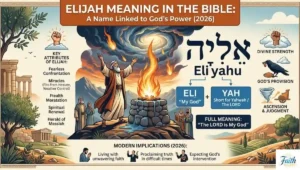
Also Read : Elijah Meaning in the Bible: A Name Linked to God’s Power (2026)
James the Disciple
The James Bible record shows two prominent apostles named James in the New Testament:
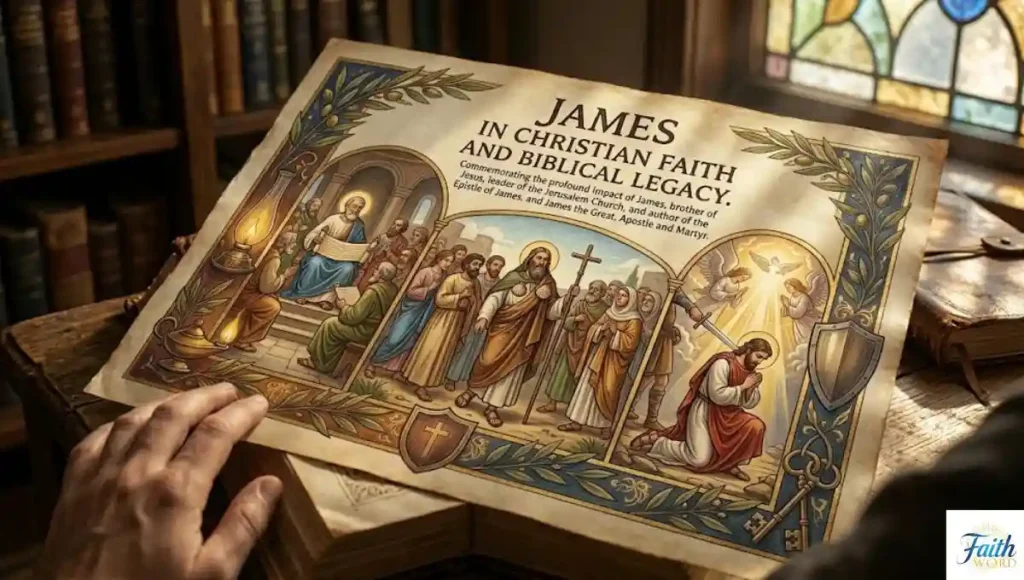
- James the Greater—Son of Zebedee and brother of John. He was among Jesus’ inner circle, witnessing the Transfiguration (Matthew 17:1) and Gethsemane (Matthew 26:37). He was beheaded under Herod Agrippa as recorded in the Book of Acts, making him the first apostle to die as a martyr for Christ.
- James the Lesser—Son of Alphaeus and one of the Twelve Apostles (Matthew 10:3), known for his quiet but steadfast faith.
- James the Just—The half-brother of Jesus, who initially doubted Jesus’ ministry (John 7:5) but became a pillar of the early church after witnessing the resurrection. He was known as a pillar of the faith (Galatians 2:9) and authored the Epistle of James.
James and Spiritual Strength
The James Bible legacy is inseparable from spiritual courage. James the Greater left his fishing nets without hesitation when Jesus called (Matthew 4:21-22). James the Just stood before the Jerusalem Council and delivered a decisive ruling that shaped the entire Gentile mission of the Church (Acts 15:13-21). Both men demonstrate that the James Bible name is synonymous with bold, God-directed action.
A Symbol of Wisdom
Perhaps no single James Bible contribution is more treasured than the wisdom literature found in the Epistle of James. The book of James looks a bit like the Old Testament book of Proverbs dressed up in New Testament clothes, with a consistent focus on practical action in the life of faith.
James 1:5 is one of the most-quoted promises in all of Scripture:
“If any of you lacks wisdom, let him ask of God, who gives to all liberally and without reproach, and it will be given to him.”
This single verse defines a core James Bible truth: godly wisdom is freely available to every believer who asks in faith.
James and Trials in Life
The James Bible message on suffering is both honest and deeply encouraging. James teaches that testing of faith produces perseverance, and that perseverance produces maturity and completeness lacking nothing. He does not minimize pain. He reframes it.
James 1:2-4 commands believers to “count it all joy” when trials come not because the trial is pleasant, but because God is using it to build something eternal in the believer’s character.
Warning Meaning of James
The James Bible also carries serious warnings that are as relevant today as they were in the first century:
- James 4:4—Friendship with the world means hostility toward God
- James 4:13-14—Arrogance about the future ignores God’s sovereignty over life
- James 5:1-6—Hoarding wealth at the expense of the poor brings divine judgment
- James 1:22—Hearing God’s Word without obeying it is self-deception
These warnings show that the James Bible name is not only about blessing. It is also about accountability before a holy God.
James in Christian Faith and Biblical Legacy
The Leadership of James in the Early Church
James was initially a doubter like his other siblings, he questioned Jesus’ ministry but after witnessing the resurrection, everything changed. He became a devoted believer and a key leader of the Jerusalem church.
His leadership was remarkable. He presided over the Jerusalem Council (Acts 15), arbitrating one of the most significant theological debates in Church history. Whether Gentile believers needed to follow Jewish law. His wise, Scripture-rooted decision helped the Gospel spread freely to the entire non-Jewish world.
Lessons from the Book of James
The Epistle of James is one of the most practically focused books in the entire Bible. Its five chapters address:
| Chapter | Theme | Key Verse |
| Chapter 1 | Trials, temptation, and seeking wisdom | James 1:5 |
| Chapter 2 | Faith demonstrated through works | James 2:17 |
| Chapter 3 | The power and discipline of the tongue | James 3:10 |
| Chapter 4 | Warnings against pride and worldliness | James 4:7 |
| Chapter 5 | Patience, prayer, and perseverance | James 5:16 |
Each chapter builds upon the central message that genuine faith transforms both the heart and daily life.
James as an Example of Faith in Action
The James Bible figure modeled what he preached. He was known in early church tradition as “James the Just” a man of extraordinary prayer whose knees were reportedly calloused from hours spent in intercession. Tradition holds that James died as a martyr in AD 62 for his faith.
He lived James 2:17 before he ever wrote it: “Faith by itself, if it does not have works, is dead.”
How James Inspires Believers Today
The James Bible legacy continues to speak powerfully into modern Christian life:
- It challenges believers to act on what they believe, not just profess it
- It calls the Church to care for the poor and vulnerable (James 1:27)
- It teaches that prayer changes things—the prayer of a righteous person is powerful and effective (James 5:16)
- It reminds us to tame the tongue—our words reveal the true condition of our hearts (James 3:6-8)
Spiritual Significance and Symbolism of James Bible Meaning

The James Bible name carries layered spiritual symbolism that speaks directly into a believer’s identity:
- “He who follows closely”—James calls believers to discipleship, walking in step behind Jesus
- “May God protect” (Latin root) the name James declares divine covering and safety
- Supplanter—in the Jacob/James tradition, this represents spiritual transformation: what once operated in the flesh is redeemed and redirected for God’s purposes
- Pillar—Paul called James a “pillar” of the church (Galatians 2:9), symbolizing foundational strength and unmovable faith
Together, these symbols paint the James Bible portrait of a believer who is protected by God, transformed from within, and standing firm as a foundation for others.
Biblical Interpretations in Dreams or Real Life
When the name James or its themes appear in dreams or repeated life experiences, biblical wisdom suggests several possible spiritual meanings:
- A call to action—Are you hearing God’s Word but not yet living it? (James 1:22)
- An invitation to ask for wisdom—God is ready to give it generously (James 1:5)
- A reminder to persevere—Your trial is producing something valuable in your spiritual character
- A prompt toward humility—James 4:10 declares, “Humble yourselves before the Lord, and He will lift you up”
As with all spiritual impressions, test them carefully against Scripture and seek godly counsel. The James Bible teaches discernment not superstition.
Practical Lessons & Faith Insights—James Bible Meaning
The James Bible provides some of the most actionable guidance in all of Scripture. Here are six life-changing faith insights drawn directly from its pages:
- Ask for wisdom boldly—God is not reluctant to give it; He distributes it “liberally” (James 1:5)
- Let trials build you—every difficulty God allows has a refining purpose in your life (James 1:3-4)
- Be a doer, not just a hearer—spiritual growth requires obedient action, not passive listening (James 1:22)
- Control your words—the tongue can build up or tear down; discipline your speech daily (James 3:9-10)
- Resist the devil—James 4:7 promises that when you resist him, he will flee
- Pray without ceasing—the fervent prayer of a righteous person accomplishes great things (James 5:16)
FAQs
Q1. What is the James Bible meaning of the name James?
James comes from the Hebrew Ya’akov (Jacob), meaning “he who grabs the heel,” “one who closely follows,” or through Latin “may God protect.”
Q2. How many people named James are in the Bible?
There are at least three prominent figures: James the Greater (son of Zebedee), James the Lesser (son of Alphaeus), and James the Just (half-brother of Jesus).
Q3. Who wrote the Book of James in the Bible?
The Epistle of James was written by James the Just, the half-brother of Jesus and leader of the Jerusalem church, likely between AD 44–62.
Q4. What is the main message of the James Bible Epistle?
The central message is that genuine faith must be demonstrated through action. Faith without works is dead (James 2:17).
Q5. What does the James Bible say about trials?
James teaches that trials produce perseverance and spiritual maturity, and believers should count them as opportunities for growth rather than occasions for despair (James 1:2-4).
Q6. What does the James Bible say about wisdom?
James 1:5 promises that God will generously give wisdom to anyone who asks in faith, without finding fault or holding back.
Q7. Why is James called a “pillar” of the church?
Paul called James a pillar in Galatians 2:9 because of his foundational role as the leader of the Jerusalem church and his unshakeable, action-based faith.
Q8. Is the name James still spiritually significant for believers today?
Absolutely, the James Bible legacy of wisdom, perseverance, and active faith continues to inspire and challenge Christians around the world every day.
Conclusion
The James Bible meaning is one of the richest name studies in all of Scripture weaving together a Hebrew patriarch’s story of transformation, two fearless apostles, and the half-brother of Jesus who led the early Church with wisdom and courage.
From its Hebrew roots meaning “he who follows closely” to the Latin declaration “may God protect,” the name James is a lifelong spiritual identity for every believer who carries it. The James Bible calls you to follow God closely, trust Him through trials, and let your faith speak loudest through the way you live.
More than any other New Testament letter, the Epistle of James bridges belief and behavior reminding every generation of Christians that what you claim to believe must be seen in how you treat others, use your words, and respond to hardship. The James Bible is not merely history. It is a living invitation to pursue wisdom, endure with joy, and demonstrate a faith that genuinely changes everything about the way you live.

Welcome to Thefaithword! I’m Abdul Mannan Haider. Christian Faith Writer | 10+ Years Bible Study Experience | Founder of (thefaithword.com)
Sharing prayers, blessings, and biblical wisdom to strengthen your faith.