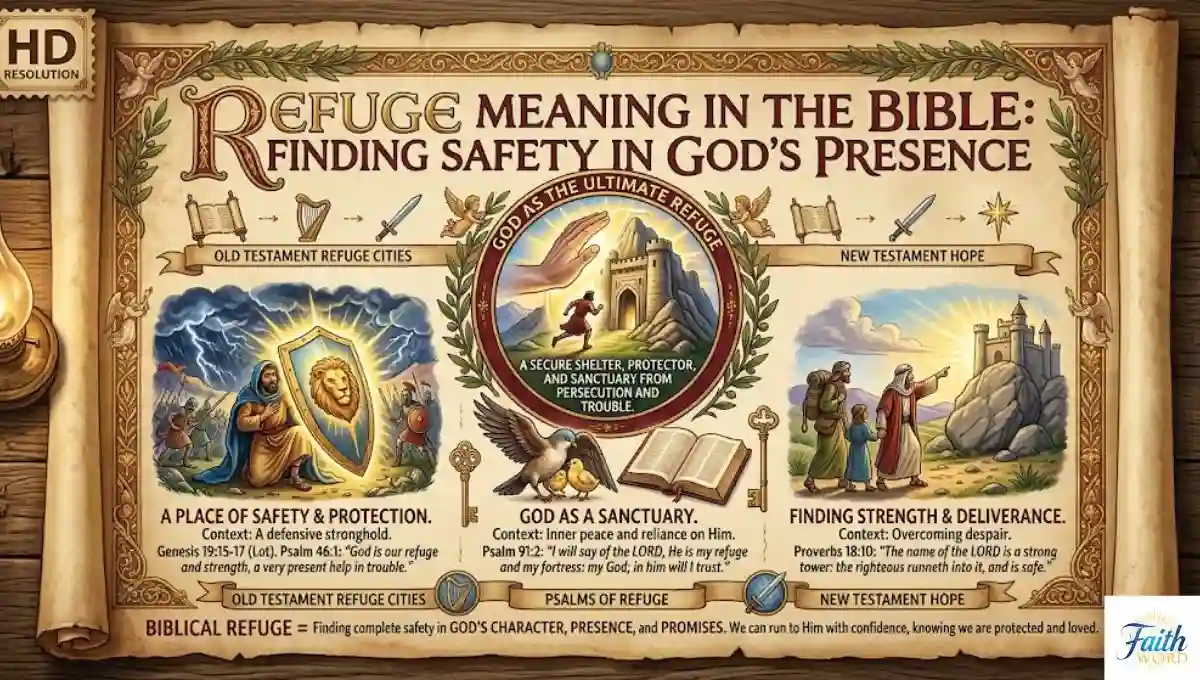
Refuge meaning in the Bible refers to God as our ultimate place of safety, protection, and spiritual security during life’s storms. The biblical meaning of refuge is deeply rooted in Scripture, especially in the Psalms, where God is described as our refuge and strength, a stronghold, and a hiding place for those who trust Him. Understanding the spiritual meaning of refuge helps believers realize that trusting God during life storms brings divine protection, emotional safety, and inner peace.
Bible verses about refuge highlight how taking refuge in God means surrendering fear, relying on His presence, and finding rest in His unchanging care. Whether exploring the meaning of “take refuge in the Lord” in Psalms or seeking comfort through God as our refuge and strength, Scripture consistently reveals a safe place in Christianity where faith, hope, and spiritual resilience are renewed.
What the refuge meaning in the Bible reveals about God’s character:
- The refuge meaning points first to a threat — Scripture always uses this word in the context of something dangerous, wrong, or overwhelming in the world
- God is not merely a source of refuge — He is refuge itself; a living shelter, not a stone building
- The refuge meaning in the Psalms is, in a sense, an Old Covenant rendering of John 3:16 — a call to find shelter from judgment, danger, and spiritual ruin in God alone
- Those who depend on riches, self-sufficiency, or earthly power for shelter will be ruined; only those who trust God will be sheltered from what ultimately destroys
- The refuge meaning covers three simultaneous dimensions: physical protection, emotional peace, and eternal spiritual safety in Christ
| Hebrew/Greek Term | Transliteration | Core Meaning | Key Verse |
| מַחֲסֶה | Machaceh | Shelter, place of safety | Psalm 46:1 |
| מִשְׂגָּב | Misgab | High fortress, inaccessible stronghold | Psalm 46:7, 11 |
| חָסָה | Hasah | To take refuge, to trust in for protection | Psalm 91:4 |
| עֹז | Oz | Strength, might, stronghold | Psalm 46:1 |
| סֶתֶר | Seter | Hiding place, shelter from storm | Psalm 91:1 |
| πύργος | Pyrgos (Greek) | Tower, fortified place | Proverbs 18:10 LXX |
Read More : 2 Crows Meaning in Bible: Biblical Symbolism, Spiritual Messages, and Faith Insights
Biblical Meaning of Refuge in the Bible
The refuge meaning in the Bible is not a single concept wrapped in a single word — it is a multi-layered, multi-dimensional truth expressed through at least six Hebrew words, dozens of metaphors, and some of Scripture’s most memorable passages. At its core, the refuge meaning declares that God is the only shelter that holds when everything else collapses.
In the Bible, “refuge” refers to a place of safety, protection, and shelter from danger or distress — it is often used metaphorically to describe God as a source of comfort and security for those who seek Him. But the refuge meaning goes far deeper than metaphor. It carries the weight of covenant commitment — God is not offering temporary shelter to strangers. He is pledging permanent protection to His own people.
The word “refuge” in Psalm 46:1 is translated from the Hebrew word machaceh (מַחֲסֶה) and it means that God is a shelter — this word is found 16 times throughout the Psalms to show how God protects His people. The fact that the Psalms — the Bible’s book of honest human emotion — use this word 16 times is not accidental. People who were afraid, hunted, betrayed, and overwhelmed wrote these songs, and their consistent, repeated conclusion was the same: God is the refuge.
1. Protection from Fear
The refuge meaning in its most immediate expression is freedom from fear — not freedom from danger but freedom within it. Psalm 46:1–2 declares this with stunning clarity: “God is our refuge and strength, an ever-present help in trouble. Therefore we will not fear, though the earth give way and the mountains fall into the heart of the sea.”
The logic is deliberate: because God is refuge, fear loses its grip. The mountains may fall. The earth may give way. The storm may be completely real — and still the believer stands without fear because the refuge they have run to is more stable than the ground beneath them.
Bible verses anchoring the refuge meaning as protection from fear:
- Psalm 91:2 — “I will say of the Lord, ‘He is my refuge and my fortress, my God, in whom I trust.'”
- Proverbs 18:10 — “The name of the Lord is a fortified tower; the righteous run to it and are safe.”
- Isaiah 41:10 — “Do not fear, for I am with you; do not be dismayed, for I am your God.”
- Nahum 1:7 — “The Lord is good, a refuge in times of trouble. He cares for those who trust in Him.”
- 2 Samuel 22:3 — “My God is my rock, in whom I take refuge, my shield and the horn of my salvation.”
2. Shelter in Emotional Storms
The refuge meaning in the Bible does not restrict itself to physical danger. Scripture is remarkably honest about the storms that happen inside people — grief, anxiety, despair, depression, loneliness — and it applies the same word to those interior conditions: refuge.
Life often brings storms, grief, loss, worry, and confusion — and the Bible uses the image of refuge to show how God gives peace during these moments, inviting people to share their fears with God, because refuge is not just protection from danger but a place of spiritual peace.
When anxiety threatens to drown you, Philippians 4:6–7 translates the refuge meaning into the language of the New Testament: “Do not be anxious about anything, but in every situation, by prayer and petition, present your requests to God. And the peace of God, which transcends all understanding, will guard your hearts and your minds in Christ Jesus.” That word “guard” is a military term — God’s peace stationed at the gate of your mind like a sentinel. This is the refuge meaning applied to the most personal and private battles believers fight.
3. Deliverance from Spiritual Danger
The deepest layer of the refuge meaning in the Bible is the one that stretches into eternity. The Old Testament’s use of “refuge” calls to mind the fact that clinging to Jesus as our Lord and Savior is the only way to find shelter from God’s judgment — only those who seek refuge from judgment by trusting God will be sheltered from eternal ruin.
This is the refuge meaning at its most profound — not just shelter from enemies or emotional pain, but shelter from the ultimate consequence of sin. Christ is the fulfillment of every city of refuge, every Psalm of shelter, every invitation to run to God. In Him, the sinner running from judgment finds mercy, and the saint running from danger finds strength.
God as Our Ultimate Refuge and Strength
Understanding the refuge meaning fully means understanding that God does not merely offer refuge — He is refuge. This is not a subtle distinction. A building can be bombed. A fortress can be breached. A city can fall. But God Himself, as the refuge, cannot be compromised.
Christ, who is God as well as man, is the “refuge” for souls to fly unto for safety — as for sensible sinners in a view of danger, wrath, and misery, so for saints in every time of distress, typified by the cities of refuge under the legal dispensation — and He is the strength from whom believers have every renewal and supply to exercise grace, perform duties, withstand enemies, bear the cross patiently, and hold on unto the end.
Why God alone qualifies as the ultimate refuge meaning for every believer:
- He is omnipresent — there is no location, no crisis, no depth of despair where He cannot reach
- He is omnipotent — no enemy that pursues you is stronger than the God who covers you
- He is eternal — His refuge does not expire, close for renovations, or run out of capacity
- He is personal — Psalm 46:1 says He is an “ever-present help,” not a distant emergency service
- He is inviting — Psalm 91:2 shows the believer making a declaration: “I will say of the Lord…” — refuge is entered through active, deliberate trust
- He is complete — the refuge meaning covers body, soul, mind, and eternity in a single shelter
Psalm 46 is called a “song of holy confidence” by Charles Spurgeon, also known as “Luther’s Psalm,” as Martin Luther wrote his popular hymn “A Mighty Fortress Is Our God” using Psalm 46 as a starting point — a 500-year-old testimony to the enduring power of the refuge meaning in Scripture.
Spiritual Significance and Symbolism

The refuge meaning in Scripture carries some of the Bible’s most vivid and layered spiritual symbolism — each image a different angle on the same irreplaceable truth.
What refuge symbolizes spiritually across Scripture:
- A rock — Unmovable, unchanging, solid beneath you when the ground gives way (Psalm 18:2)
- A fortress — Military-grade protection; impenetrable from the outside for those sheltered within (Psalm 46:7)
- A shadow of wings — Tender, intimate, close — the protection of a parent over a helpless child (Psalm 91:4)
- A high tower — Elevation above the reach of every enemy and every threat (Psalm 61:3)
- A city of refuge — A specific, designated place of safety available to all who run to it without hesitation (Numbers 35)
- A present help — Not a distant theological concept but an immediately available, actively engaged God (Psalm 46:1)
- A hiding place — Intimate concealment in the secret place of God’s presence (Psalm 91:1)
Think of a child hiding under a blanket during thunder — the storm still roars outside, but the child feels safe. In the same way, refuge does not always remove the storm. It gives peace inside it. Psalm 91 describes God covering His people with His feathers, like a bird protecting its young.
This image captures the refuge meaning in the Bible with extraordinary tenderness. God does not promise to remove every storm from His people’s lives — He promises to be the covering that makes surviving the storm not just possible but transformative.
How to Trust God as Your Refuge in Daily Life
Understanding the refuge meaning theologically is one thing. Actually running to God as your refuge when fear closes in is another. The refuge meaning becomes practically alive only when it is applied — deliberately, consistently, and with faith that requires action.
How to actively practice the refuge meaning in your daily walk:
- Declare it first — Psalm 91:2 says “I will say of the Lord, ‘He is my refuge'” — speak it aloud over your situation before you allow anxiety to speak first
- Run, do not walk — The cities of refuge were only effective for those who actually ran to them; hesitation was deadly — make prayer your immediate first response, not your last resort
- Bring the specific fear — God does not need vague spiritual surrenders; name the threat in prayer, just as David named his enemies specifically in the Psalms
- Anchor in Scripture — The refuge meaning loses its practical power when it is separated from God’s Word; keep the verses that speak to refuge in front of you during hard seasons
- Practice stillness — Psalm 46:10’s command “Be still and know that I am God” is the active practice of the refuge meaning — stopping the anxious motion long enough to experience the shelter
- Gather in community — The refuge is not just personal; corporate worship, prayer, and fellowship are extensions of the refuge meaning into the relational dimension of faith
- Return repeatedly — Running to God as refuge is not a one-time act; it is a daily, moment-by-moment choice to trade your anxiety for His peace
Biblical Interpretations in Dreams or Real Life
The refuge meaning can surface in dreams and daily life encounters in ways that carry clear spiritual significance for the attentive believer.
If you dream of finding shelter or safety: The refuge meaning in this dream context often signals that God is inviting you into a deeper level of trust — a spiritual season where He is asking you to stop trying to manage your own protection and rest in His.
If you dream of being pursued and reaching safety: This mirrors the cities of refuge narrative — God may be reassuring you that His mercy is available even for failures and mistakes you believe disqualify you from His protection.
If you dream of a fortress, a rock, or a high place: These are direct scriptural symbols of the refuge meaning — God may be confirming His role as your stronghold in a situation where you have been trying to build your own walls.
The refuge meaning encountered in real life situations:
| Life Situation | Refuge Meaning Applied | Biblical Response |
| Sudden fear or panic attack | God is your ever-present help — run to prayer immediately | Psalm 46:1 — He is a very present help |
| Betrayal by a trusted person | God is the refuge that humans cannot replace | Psalm 31:15 — “My times are in your hands” |
| Career loss or financial crisis | His provision and protection extend to practical needs | Proverbs 18:10 — run to His name as a tower |
| Health diagnosis or physical threat | His wings cover you even in the valley of death | Psalm 23:4 — “I will fear no evil” |
| Spiritual attack or oppression | He is a high fortress above the reach of the enemy | Psalm 59:16 — “You are my fortress, my refuge in times of trouble” |
| Grief, loneliness, or emotional pain | He is near to the brokenhearted — draw near to receive | Psalm 34:18 — close to the crushed in spirit |
Practical Lessons and Faith Insights
The refuge meaning in the Bible is not stored in a theological library — it is meant to be lived in the ordinary, sometimes terrifying, always transformative spaces of real human experience:
- Stop treating God as a last resort — the refuge meaning works best for those who run to Him first, not after every human option has failed
- Declare your trust before you feel it — “I will say of the Lord, He is my refuge” is a faith statement, not a feeling statement; make the declaration and let the peace follow
- Let the Psalms teach you how to run to God — no other biblical book models the practice of the refuge meaning more consistently or more honestly
- Reject the lie that self-sufficiency is strength — the refuge meaning exposes self-reliance as the most dangerous form of spiritual vulnerability; the strongest people in Scripture were those who knew they needed God most urgently
- Build your life around the metaphors — rock, fortress, tower, shadow of wings, hiding place — let these images reshape how you think about God every single day
- Expect the refuge to be tested — every storm you survive in God’s shelter becomes testimony; the trials that drive you to the refuge are also producing something irreplaceable in your faith
- Teach the refuge meaning to others — Psalm 46 was written for congregational worship; this truth was never meant to stay private between you and God alone
Conclusion
The refuge meaning in the Bible is not a comforting idea for spiritually fragile people — it is a battle-tested, theologically precise, personally offered reality from a God who has positioned Himself as the only shelter strong enough to hold when every other protection in the world gives way.
From the Hebrew machaceh of Psalm 46:1 to the cities of refuge in Numbers 35, from David hiding in the cave to Martin Luther writing “A Mighty Fortress Is Our God,” the refuge meaning across Scripture declares one unmovable truth: God is not waiting for you to get strong enough to face the storm.
He is waiting for you to run to Him so that the storm meets His strength instead of yours. Make the refuge meaning practical today — speak it, run to it, anchor in it, and rest in the only shelter that has never once collapsed on those who trusted it.
FAQs
What is the refuge meaning in the Bible?
The refuge meaning in the Bible refers to God as a living, personal shelter of safety, strength, and protection — available to every believer who chooses to run to Him in times of danger, fear, or spiritual crisis.
What does Psalm 46:1 mean when it says God is our refuge?
The Hebrew word machaceh in Psalm 46:1 means God is a shelter — not a passive concept but an active, ever-present, immediately available protection for those who trust Him in times of trouble.
What were the cities of refuge in the Bible?
The cities of refuge were six designated Levitical cities in the Old Testament (Numbers 35, Joshua 20) where people who caused accidental death could flee for protection, mercy, and a fair trial — typifying Christ as our eternal refuge from judgment.
How can I practically find refuge in God during anxiety?
Find refuge in God by declaring Psalm 91:2 aloud in prayer, running to God before every other option, anchoring your mind in Scripture, practicing deliberate stillness before Him, and trusting His presence over your circumstances.
Why is God called both refuge and strength in Psalm 46:1?
God is called both because refuge alone without strength produces passive hiding, and strength alone without refuge produces proud self-reliance — together they describe a God who shelters the humble and empowers those who trust Him to endure, overcome, and glorify Him through every trial.

Welcome to Thefaithword! I’m Abdul Mannan Haider. Christian Faith Writer | 10+ Years Bible Study Experience | Founder of (thefaithword.com)
Sharing prayers, blessings, and biblical wisdom to strengthen your faith.