

The Levi meaning in the Bible is far richer than most people realize. At its surface, Levi is the name of Jacob’s third son but beneath that lies a story of flawed beginnings, divine calling, radical transformation, and a priestly legacy that echoes all the way into the New Testament. Whether you are studying the tribe of Levi, the apostle Matthew who was also called Levi, or simply exploring what this name means for your own spiritual life, the Levi meaning carries timeless lessons about how God transforms broken people into vessels of sacred purpose. This article unpacks every powerful layer of that truth.
Have you ever wondered why the name Levi holds such a special place in the Bible? More than just a biblical name, Levi carries a powerful spiritual meaning connected to worship, service, faithfulness, and God’s divine calling. As one of Jacob’s sons and the ancestor of the Tribe of Levi, his legacy became deeply linked to the priesthood and the sacred work of serving God.
Understanding the Levi meaning in the Bible reveals important lessons about devotion, spiritual growth, obedience, and drawing closer to God. Whether you encountered this name in Scripture, prayer, or a dream, exploring its biblical symbolism can provide valuable insight for your faith journey and help you discover deeper truths about God’s purpose for His people.
Biblical Meaning of Levi in the Bible
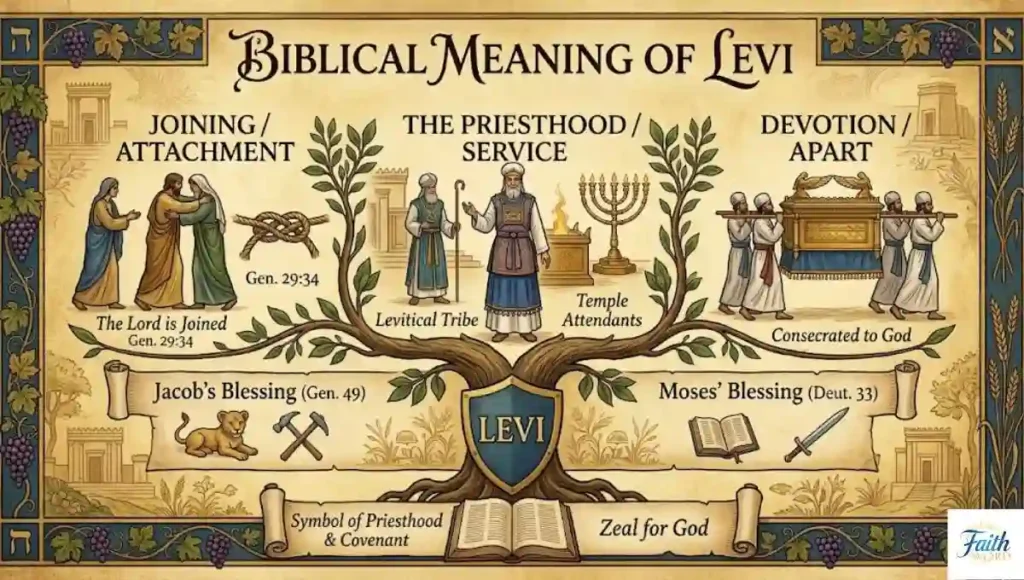
The name Levi comes from the Hebrew root lavah (לָוָה), meaning “to join,” “to attach,” or “to be connected.” When Leah gave birth to her third son, she declared in Genesis 29:34:
“Now at last my husband will become attached to me, because I have borne him three sons.”
That single verse reveals the emotional and relational depth behind the Levi meaning. A name born from a longing for closeness, for belonging, and for being truly joined to another person. But God took that human desire for attachment and elevated it into something eternal: a tribe that would be permanently attached to Him.
1. Levi Represents Connection to God
The deepest Levi meaning is spiritual connection not to other people, but to God Himself. Unlike every other tribe of Israel, the Levites received no territorial inheritance in the Promised Land. Instead, God declared in Numbers 18:20:
“I am your portion and your inheritance among the people of Israel.”
This is extraordinary. While other tribes received land, livestock, and cities, the Levi meaning of their inheritance was God Himself. They were permanently attached to the Lord living out the root meaning of their name in the most profound way possible.
2. Levi Symbolizes Service and Ministry
The Levi meaning in the context of ministry is one of the most significant themes in all of Scripture. The tribe of Levi was set apart by God for sacred service. A calling that shaped all of Israel’s worship life.
The Levites served in three distinct capacities:
| Role | Description | Scripture |
| Priests (Kohanim) | Sons of Aaron — offered sacrifices, entered the Holy Place | Leviticus 1–9 |
| Levitical Servants | Carried the Tabernacle, assisted priests, led worship | Numbers 3:6-9 |
| High Priest | Entered the Most Holy Place once yearly on Yom Kippur | Leviticus 16 |
| Teachers of the Law | Instructed Israel in God’s commandments | Deuteronomy 33:10 |
This structure shows that Levi meaning in biblical ministry is not about personal ambition. It is about being set apart for a purpose that serves the entire community before God.
Moses and Aaron, two of the most pivotal figures in all of Scripture, were both Levites. Moses led Israel out of Egyptian captivity and received the Law at Mount Sinai. Aaron served as the first High Priest of Israel. Both men demonstrate that those who carry the Levi meaning are positioned by God for extraordinary leadership and intercession.
3. Levi Shows God’s Power to Transform
Perhaps the most stunning dimension of the Levi meaning is what it reveals about God’s transforming grace. Levi’s early story was not glorious. In Genesis 34, Levi and his brother Simeon took violent revenge on the people of Shechem for the dishonoring of their sister Dinah. Jacob publicly rebuked them, and in his final blessing in Genesis 49:5-7, he declared their descendants would be scattered throughout Israel.
This was a curse. Yet God turned it into a calling.
Instead of being scattered in disgrace, the Levites were scattered throughout Israel as priests, teachers, and ministers of God’s presence. What Jacob meant as a judgment, God redeemed into a mission. The Levi meaning of transformation speaks powerfully to every person who believes their past disqualifies them from divine purpose.
This same theme appears in the New Testament. A man named Levi better known as Matthew was a tax collector when Jesus called him. Tax collectors were social outcasts in first-century Israel, despised for collaborating with Roman oppression. Yet Jesus walked up to Levi’s tax booth and said two words: “Follow me” (Matthew 9:9). Levi stood up, left everything, and became one of the Twelve Apostles and the author of the first Gospel.
The Levi meaning of transformation is consistent across both Testaments: God calls the unlikely and remakes them entirely.
Read More : Hannah Meaning in the Bible: A Story of Faith, Prayer, and God’s Faithful Answer
4. Levi Can Also Be a Warning
The Levi meaning carries a sobering dimension as well. The Levites were entrusted with the holiest responsibilities in Israel and when they failed, the consequences were severe. Numbers 16 records the rebellion of Korah, a Levite who challenged Moses and Aaron’s God-given authority. His rebellion was met with swift divine judgment.
This aspect of Levi meaning warns every believer that:
- Greater calling requires greater faithfulness — those entrusted with spiritual responsibility are held to a higher standard
- Pride corrupts service — Korah’s downfall began with the belief that he deserved more than what God had assigned
- Obedience to God’s structure matters — the Levites thrived when they served within God’s design and suffered when they stepped outside it
The warning embedded in the Levi meaning is not meant to create fear, but to invite reverent, humble faithfulness.
The Origin and History of the Name Levi

The name Levi has traveled a remarkable path through biblical and world history:
| Period | Significance |
| Genesis 29:34 | Levi born — third son of Jacob and Leah |
| Genesis 34 | Levi and Simeon’s violence at Shechem |
| Genesis 49:5-7 | Jacob’s rebuke — descendants to be scattered |
| Exodus 32:26-29 | Levites stand for God after the golden calf incident chosen for priesthood |
| Numbers 3 | God formally sets apart the Levites for Tabernacle service |
| Deuteronomy 33:8-11 | Moses blesses Levi — confirming their priestly calling |
| 1 Chronicles 23 | David reorganizes the Levites for Temple worship |
| Mark 2:14 | Levi (Matthew) called by Jesus as an apostle |
| Hebrews 7 | Christ’s priesthood fulfills and surpasses the Levitical order |
The pivot point in the Levi meaning history is Exodus 32:26-29. when Moses called out after Israel’s sin with the golden calf: “Whoever is for the Lord, come to me.” The Levites alone responded. That act of faithfulness marked the moment God elevated their calling from scattered judgment to sacred priesthood.
Spiritual Significance and Symbolism
You Are Called
The Levi meaning declares that divine calling is not reserved for the perfect. Levi the patriarch made serious mistakes. Matthew the tax collector lived a compromised life. Yet both were chosen. If you carry the name Levi or simply feel drawn to its story know that God’s calling rests on grace, not on your past performance.
You Belong to God
The Levites’ inheritance was not land. It was God Himself. The Levi meaning of belonging speaks to every believer who sometimes feels unsettled, undefined, or without a clear place. In Christ, your inheritance is the same: “I am your portion” (Numbers 18:20). You belong to Him entirely.
Transformation Is Possible
From Levi’s violent beginning to the Levitical priesthood’s sacred glory from Matthew the outcast tax collector to Matthew the Gospel writer. The Levi meaning is living proof that no past is beyond God’s power to redeem. Transformation is not just possible; it is central to the Levi story.
Worship Is More Than Singing
The Levites were not just musicians though they did lead Israel in powerful worship (1 Chronicles 25). They carried the Ark of the Covenant, maintained the Tabernacle, taught the Law, and interceded before God on behalf of the nation. The Levi meaning of worship is whole-life devotion: “Whatever you do, do it all for the glory of God” (1 Corinthians 10:31).
Biblical Interpretations in Dreams or Real Life
A Call to Draw Near to God
If the name Levi appears in a dream or keeps catching your attention in daily life, the most consistent Levi meaning is an invitation to draw closer to God. Just as the Levites lived nearest to the Tabernacle and were permanently attached to the Lord, this may be God’s personal invitation to you to deepen your worship, your prayer life, and your time in His presence.
A New Assignment
The Levi meaning may signal a shift in spiritual calling. Just as the Levites were reassigned from scattered judgment to sacred ministry, God may be preparing you for a new role. A ministry, a leadership opportunity, or a specific act of service you have not yet walked into.
Personal Transformation
Seeing or dreaming of Levi may point to a season of personal transformation. The Levi meaning carried by Matthew from tax collector to apostle is one of the Bible’s clearest pictures of radical life change through an encounter with Jesus Christ.
Need for Faithfulness
Like the warning of Korah’s rebellion, a prompting through the Levi meaning may be a gentle nudge toward greater faithfulness. Are you serving God with integrity? Are you honoring the spiritual responsibilities He has placed in your hands? As with all spiritual impressions, test them against Scripture and seek God in prayer.
Practical Lessons & Faith Insights
The Levi meaning in the Bible generates six powerful, practical lessons for every believer:
- Your past does not determine your calling — Levi the patriarch began with failure; his tribe ended in priestly glory. God’s purposes are not limited by your history.
- God Himself is your inheritance — Like the Levites who received no land, believers who fully surrender to God find that He alone is more than enough (Psalm 16:5).
- Being set apart requires living differently — The Levites were holy because they were called to holiness. The Levi meaning invites every believer to take their consecration seriously (1 Peter 2:9).
- Service is a sacred privilege, not a burden — The Levites cared for the Tabernacle not as a duty, but as an honor. Serve your local church, your community, and God’s people with the same reverence.
- Jesus fulfills what Levi began — Hebrews 7 teaches that Christ is the ultimate High Priest, surpassing the Levitical order. Every priest who ever served pointed forward to Him.
- Anyone can be called — Matthew/Levi was the least likely apostle by society’s standards. The Levi meaning declares that Jesus’ invitation is open to everyone, regardless of background, reputation, or past.
FAQs
Q1. What is the Levi meaning in the Bible?
Levi means “joined,” “attached,” or “connected” in Hebrew pointing to spiritual closeness with God and a calling to priestly service.
Q2. Who was Levi in the Old Testament?
Levi was the third son of Jacob and Leah, the patriarch of the tribe of Levi, which became Israel’s priestly tribe set apart for sacred service (Genesis 29:34).
Q3. Why were the Levites chosen to be priests?
After Israel’s golden calf sin, the Levites alone stood for God (Exodus 32:26-29), and God honored their faithfulness by appointing them as the priestly tribe of Israel.
Q4. What was the Levitical priesthood?
The Levitical priesthood was the God-ordained system of priests and temple servants descended from Levi, responsible for sacrifices, worship, teaching the Law, and maintaining the Tabernacle and Temple.
Q5. Is Levi the same person as Matthew in the Bible?
Yes, Mark and Luke refer to the apostle as Levi, while the Gospel of Matthew calls him by his new name, reflecting his transformation from tax collector to apostle.
Q6. What does Levi meaning teach about transformation?
From Levi’s violent beginning to the Levitical priesthood’s glory, and from Matthew’s outcast status to apostleship, the Levi story demonstrates that God transforms the most unlikely people for the greatest purposes.
Q7. What is the spiritual significance of having no land inheritance?
The Levites’ inheritance was God Himself (Numbers 18:20), symbolizing that the deepest Levi meaning is complete dependence on and attachment to God above all earthly possessions.
Q8. How does Jesus relate to the Levi meaning and priesthood?
Hebrews 7 declares that Jesus is the ultimate High Priest not from the Levitical line but from the eternal order of Melchizedek fulfilling and surpassing everything the Levitical priesthood foreshadowed.
Conclusion
The Levi meaning in the Bible is one of Scripture’s most layered and spiritually rich name studies. From Jacob’s third son whose name meant “attached,” to a tribe chosen for priestly service, to a New Testament tax collector transformed into an apostle every chapter of the Levi story declares the same unchanging truth: God takes broken, unlikely people and attaches them to Himself for eternal purposes. The Levi meaning is ultimately a message of belonging, transformation, and sacred calling that speaks directly into the life of every believer who dares to say yes to God’s invitation.
Whether you are drawn to the Levi meaning through genealogy, personal name study, or a deep hunger to understand your own spiritual identity, the answer the Bible gives is consistent and beautiful. You are called. You are attached to God. Your past does not disqualify you. And just as the Levites discovered that their inheritance was God Himself, every believer who surrenders to His call finds the same inexhaustible, eternal portion. A life fully joined to the living God.

Welcome to Thefaithword! I’m Abdul Mannan Haider. Christian Faith Writer | 10+ Years Bible Study Experience | Founder of (thefaithword.com)
Sharing prayers, blessings, and biblical wisdom to strengthen your faith.