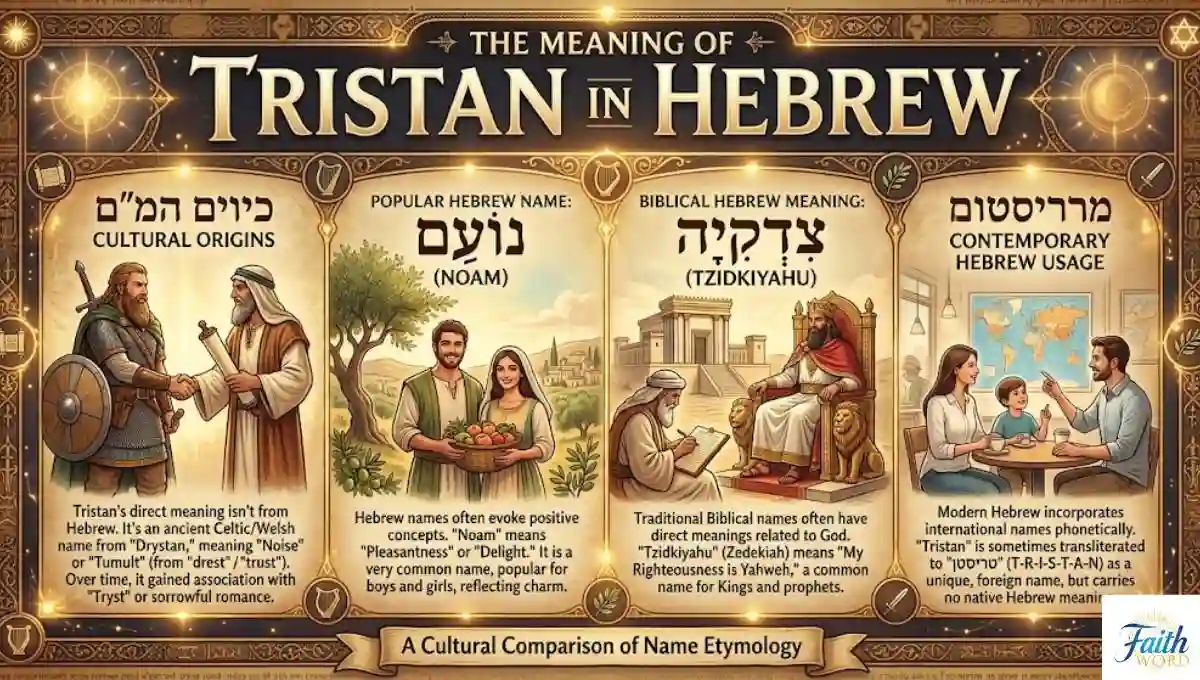
The Tristan meaning in Hebrew is a topic that many people search when exploring the biblical interpretation of names and the deeper spiritual meaning of names in the Bible. Although Tristan is not found in Scripture and is not a traditional Hebrew name, its roots come from a Celtic name Tristan meaning “sorrowful” or “full of emotion,” later influenced by Old French origin Tristan.
This naturally raises questions like “is Tristan in the Bible?” or “what does Tristan mean spiritually?” as people try to connect modern names with Christian name symbolism and biblical virtues meaning. While there is no direct Hebrew meaning of Tristan, its symbolic interpretation can still reflect themes such as trust and faithfulness in the Bible, biblical loyalty and friendship meaning, and the broader idea of how names can carry spiritual depth in biblical teachings.
This article will help you understand whether Tristan has any biblical meaning of Tristan name, and how it can be viewed through a faith-based and spiritual lens.
Is Tristan Mentioned in the Bible?
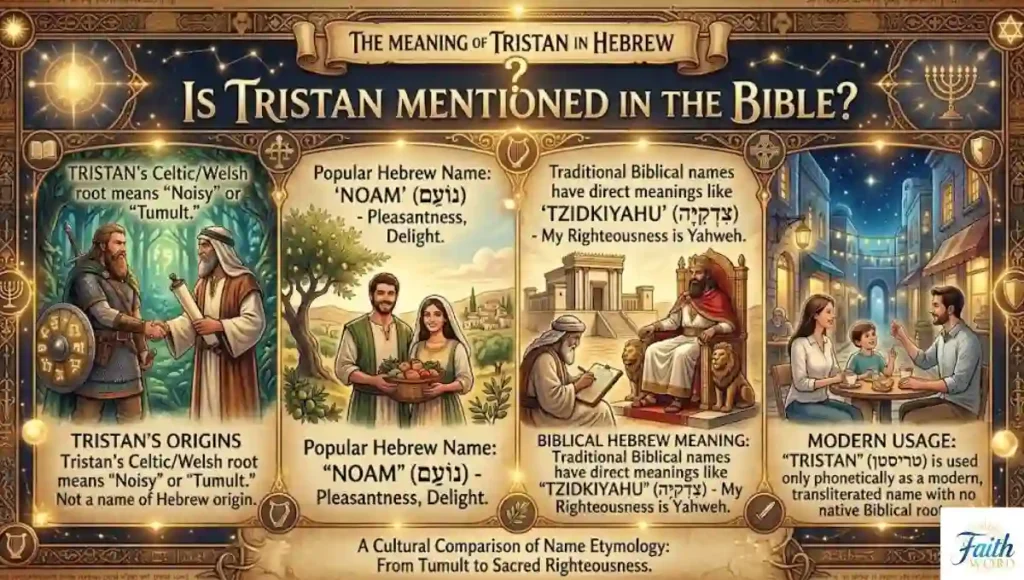
Let us be completely honest from the start. Tristan does not appear in the Bible. It is not a Hebrew, Aramaic, or Greek name, and it carries no direct scriptural origin. The name emerged from Celtic mythology and medieval French literature, traditions that developed entirely separately from the biblical world.
But here is where it gets beautiful: the absence of a name from Scripture does not make it spiritually empty. The Bible is filled with wisdom about identity, character, and calling, but it does not restrict believing families to a narrow list of biblical names. Throughout church history, Christians have given their children names from Greek, Latin, Celtic, Germanic, and countless other traditions, trusting that godly character matters far more than etymological origin.
Many people still look for the biblical meaning of Tristan by connecting its themes with biblical values and teachings. Since Tristan is commonly interpreted as “sorrowful” or “full of deep emotion,” it can be spiritually connected with many biblical themes where sorrow leads to faith and transformation.
Key facts at a glance:
- Tristan does NOT appear in the Old or New Testament
- It is NOT a Hebrew or Semitic name by origin
- It IS spiritually meaningful when viewed through biblical themes
- Its themes of sorrow, strength, and loyalty are deeply biblical
Also Read : Aiden Name Meaning in the Bible (Biblical & Spiritual Meaning)
The Hebrew Meaning and Origin of the Name Tristan

To understand the Tristan meaning in Hebrew, we must first understand where the name actually comes from, and then explore how Hebrew spiritual values speak into it.
Most scholars agree that Tristan derives from the Pictish name “Drustan” or “Drust,” which was common among the ancient Celtic peoples of Britain. The name later evolved through Old French into “Tristan,” becoming immortalized in medieval literature through the tragic romance of Tristan and Isolde.
The most widely accepted meaning of Tristan traces back to the Old French word triste and the Latin root tristis, both meaning sad or sorrowful. A secondary root comes from the Celtic name Drustan or Drostán, which carried ideas of tumult, bold action, and courageous conflict.
Here is a clear breakdown of Tristan’s linguistic roots:
| Language / Culture | Root Word | Meaning |
| Pictish / Celtic | Drust / Drustan | Tumult, noise, riot |
| Welsh | Trwst / Trystio | To clatter, loud noise |
| Old French / Latin | Triste / Tristis | Sad, sorrowful |
| Hebrew equivalent concepts | Atsab / Chozek | Grief transformed into strength |
| Modern Christian view | Thematic | Sorrow refined into purpose |
Although Tristan’s Hebrew origins do not exist in a direct linguistic sense, the Tristan meaning in Hebrew is often explored through interpretation rather than translation. There is no ancient Hebrew word for Tristan, yet the themes behind the name align closely with Hebrew biblical concepts.
In Hebrew thought, names were never just labels. They were declarations of identity and destiny. Sorrow, or yagon in Hebrew, was understood not as defeat but as a gateway to divine refinement. Hebrew Scripture is filled with people who wept before God and were heard.
Bible Verses That Reflect Tristan’s Meaning

Even without a direct biblical reference, the Tristan meaning in Hebrew spiritual context connects powerfully to Scripture. These verses mirror exactly what the name symbolizes:
- Psalm 30:5 — “Weeping may endure for a night, but joy comes in the morning.” (Sorrow is real but temporary)
- Romans 8:28 — “And we know that in all things God works for the good of those who love Him.” (God redeems every trial)
- James 1:2-4 — “Consider it pure joy when you face trials of many kinds, because the testing of your faith produces perseverance.” (Endurance through tumult)
- Philippians 4:13 — “I can do all things through Christ who strengthens me.” (Reflecting Tristan’s warrior strength)
- Joshua 1:9 — “Be strong and courageous. Do not be afraid, for the Lord your God will be with you wherever you go.” (Courage in the face of difficulty)
- 2 Corinthians 1:3-4 — “The God of all comfort, who comforts us in all our troubles.” (Divine comfort through sorrow)
- Proverbs 17:3 — “The crucible for silver and the furnace for gold, but the Lord tests the heart.” (Refinement through trials)
What Tristan represents, a journey through sorrow toward strength, is exactly what Scripture describes in figure after figure. The name did not come from the Hebrew world, but the story it tells has been written across every page of God’s Word since the beginning.
Spiritual Lessons and Life Meaning of the Name Tristan
The spiritual meaning of the name Tristan is not about sadness. It is about what happens after sadness. Tristan meaning today goes far beyond sorrow. It speaks to resilience. It hints at quiet strength. It reflects someone who endures storms and comes out refined.
In Hebrew thought, sorrow is often linked to growth, empathy, and spiritual reflection. Many figures in the Bible went through deep sorrow: Job endured loss yet remained faithful. David poured his heart out in the Psalms. Jesus wept over the suffering of others.
Spiritual qualities associated with the name Tristan:
- Deep emotional intelligence and empathy
- The capacity for authentic, heartfelt prayer
- Courage to walk through hardship without losing faith
- Loyalty that does not waver under pressure
- Transformation from brokenness to spiritual beauty
Tristan represents strength through adversity and faithful endurance. The deeper meaning reflects a journey from sorrow to joy. Many biblical figures experienced similar transformations throughout their lives. Tristan embodies the Christian concept of redemptive suffering today.
Biblical and Spiritual Significance of Tristan in Hebrew
The Tristan meaning in Hebrew spiritual framework can be beautifully mapped across five transformational pairings. Each one mirrors a core biblical truth.
Sorrow → Strength
The name begins with grief but does not end there. Hebrew wisdom consistently teaches that trials are not punishment. They are purification. Proverbs 17:3 says the Lord tests hearts the way fire tests silver. The name Tristan, tied to the theme of sorrow, can spiritually represent someone being refined rather than broken.
Tumult → Peace
The Celtic root of Tristan means “noise” and “riot.” But the God of the Bible is a God who speaks peace into storms. Psalm 46:10 says, “Be still and know that I am God.” The Tristan meaning in Hebrew context points to a soul that has learned stillness through the storm.
Warrior → Servant
Tristan’s origin reflects a blend of Celtic storytelling and Christian moral values. The name suggests a life marked by resilience, a heart shaped by faith, and a personality reflecting wisdom, courage, and compassion. The warrior spirit does not disappear. It is redirected into humble service.
Passionate Love → Divine Love
The legend of Tristan and Isolde is defined by passionate, consuming love. Biblical love goes higher. 1 Corinthians 13 describes love that endures all things, hopes all things, and never fails. The Tristan meaning in Hebrew spiritual lens transforms romantic devotion into covenant love rooted in God.
Loyalty → Faithfulness
Tristan is famous in legend for his unwavering loyalty. In Hebrew culture, the parallel virtue is chesed, the loyal, covenant-keeping love of God. The name Tristan can be associated with traits like loyalty, emotional depth, resilience, and strength, which align with virtues celebrated in Scripture.
Is It a Good Christian Name?
Absolutely yes. From a Christian perspective, the absence of a Hebrew root does not diminish the name. Many beloved Christian names used across centuries of church history carry Greek, Latin, or Germanic roots rather than Hebrew ones. What matters most to a Christian family is the meaning they prayerfully attach to a name and the life of faith they nurture in the child who bears it.
Tristan is excellent for Christian families seeking meaningful names. It represents faith, strength, and overcoming life’s challenges through God. The name symbolizes transformation from sorrow to joy through faith. It declares trust in God’s power to strengthen and redeem.
Why Christian parents love the name Tristan:
- It carries a built-in spiritual narrative of transformation
- Its meaning aligns with the gospel: suffering followed by redemption
- It is strong, distinctive, and full of character
- It invites a child to live a story of courage, depth, and faith
- It is not tied to any negative or problematic biblical figure
Tristan in Legends vs Christian Truth
The medieval legend of Tristan and Isolde is a love story marked by passion, tragedy, and ultimately death. It is beautiful in a literary sense. But Christian truth takes the same raw material of sorrow and loyalty and points it somewhere far better.
| Theme | Tristan Legend | Christian Truth |
| Sorrow | Tragic and without resolution | Transformed by God into joy |
| Loyalty | Devoted to one person unto death | Faithfulness to God and community |
| Strength | Warrior fighting for personal love | Servant-warrior fighting for God’s Kingdom |
| Love | Passionate but ultimately fatal | Covenant love that never fails (1 Cor. 13) |
| Ending | Death and despair | Resurrection and eternal hope |
The Bible often teaches that sorrow is temporary but God’s joy and restoration are lasting. This makes the symbolic meaning of Tristan more hopeful than its literal interpretation.
Christian Perspective on Naming and Identity of Tristan
In the Bible, names are not just identifiers. They are prophetic declarations. In Hebrew thought, names were never just labels. They were declarations of identity and destiny. Think of Abram becoming Abraham. Simon becoming Peter. Saul becoming Paul. Each name shift marked a spiritual transformation.
When a Christian family chooses the name Tristan, they are not simply choosing a sound they like. They are saying something about who this child is called to become. A person who has known sorrow and been made stronger by it. A person whose loyalty runs deep. A person whose passion has been purified by faith.
Choosing Tristan meaning in Hebrew carries more than aesthetic appeal. It conveys a spiritual identity rooted in faith and perseverance.
Principles for Christian naming with purpose:
- Pray over the name before deciding
- Research its meanings across all linguistic roots
- Connect the name’s themes to biblical virtues
- Speak the name’s spiritual meaning over the child as they grow
- Let the name become a daily reminder of God’s purpose for their life
Tristan Name Symbolism and Interpretation in Hebrew Culture

Tristan has no direct symbolism or traditional interpretation in Hebrew culture, as the name originates from Celtic Britain and has never been part of Jewish naming traditions or Hebrew linguistic heritage.
However, when we explore the Tristan meaning in Hebrew through a thematic lens rather than a literal one, rich connections emerge:
| Hebrew Concept | Hebrew Word | Connection to Tristan |
| Grief / Sorrow | Atsab (עָצַב) | The original meaning of the name |
| Strength / Fortitude | Chozek (חֹזֶק) | What the name grows into spiritually |
| Heart | Lev (לֵב) | The emotional depth Tristan symbolizes |
| Refinement | Tzaraf (צָרַף) | Purification through trials |
| Steadfast love | Chesed (חֶסֶד) | The loyalty the name carries |
Several Hebrew concepts mirror the Tristan Hebrew interpretation: Atsab, grief or sorrow reflecting emotional depth, and Chozek, strength, resilience, and inner fortitude. Together, these ideas shape the Tristan spiritual meaning in a Hebrew framework. Life includes pain, but faith reshapes it.
Conclusion
The Tristan meaning in Hebrew may not be found in any ancient lexicon, but its spiritual themes, sorrow, strength, loyalty, and divine transformation, are woven into every page of Scripture. The name Tristan carries a story that mirrors the biblical journey from brokenness to wholeness, from grief to God-given purpose.
For any Christian family choosing this name, it is not a compromise of faith but a beautiful declaration of trust in the God who turns mourning into joy, weakness into strength, and trials into testimonies of His faithfulness.
Frequently Asked Questions
What is the Tristan meaning in Hebrew?
Tristan has no direct Hebrew etymology, but thematically it connects to Hebrew concepts of sorrow (Atsab) refined into strength (Chozek) by God.
Is Tristan mentioned in the Bible?
No, the name Tristan does not appear anywhere in the Old or New Testament.
What is the origin of the name Tristan?
Tristan is derived from the Welsh drust meaning “noise” or “tumult,” further shaped by the French word triste meaning “bold” or “sad.”
What is the spiritual meaning of the name Tristan?
Spiritually, Tristan represents the Christian journey from sorrow and trials into strength, redemption, and deeper faith in God.
Is Tristan a good Christian name?
Yes, Tristan is a meaningful Christian name symbolizing transformation, loyalty, emotional depth, and endurance through God’s grace.
What Bible verses connect to the meaning of Tristan?
Romans 8:28, James 1:2-4, Psalm 30:5, and Philippians 4:13 all reflect the spiritual themes behind the name Tristan.
Does the name Tristan have a prophetic meaning in Christianity?
Prophetically, Tristan speaks to a life marked by refinement through hardship and the emergence of God-given strength, courage, and faithful love.

Welcome to Thefaithword! I’m Abdul Mannan Haider. Christian Faith Writer | 10+ Years Bible Study Experience | Founder of (thefaithword.com)
Sharing prayers, blessings, and biblical wisdom to strengthen your faith.