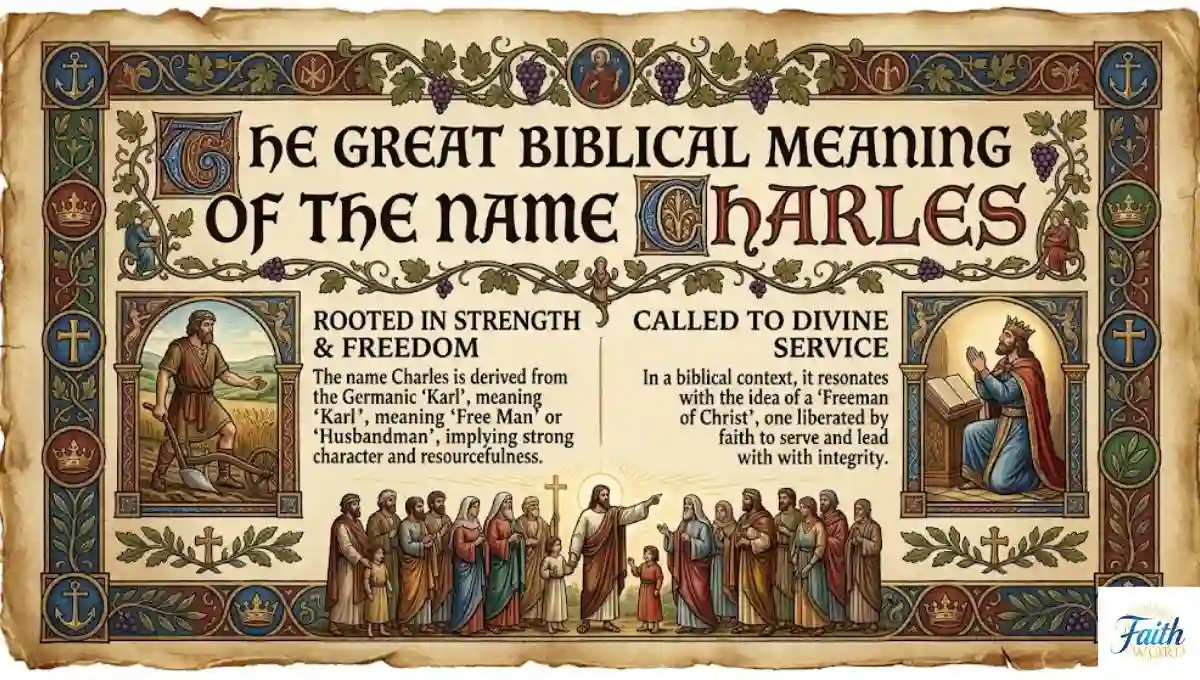
The biblical meaning of the name Charles is often explored in Christianity for its deep spiritual and moral significance. Although not mentioned directly in the Bible, the meaning of Charles in Christianity is closely associated with strength, humility, and devotion to God. Originating from the Germanic name Karl, meaning “free man,” the origin and meaning of the name Charles reflects values of courage, leadership, and faithfulness.
In a biblical interpretation of Charles, the name symbolizes Christian leadership name meanings, moral strength, and obedience to God. It is commonly linked with Christian boy names meaning strength and faith, making it a strong example of faith-based baby boy names and spiritual symbolism of names in Christianity.
Origin and Meaning of Charles
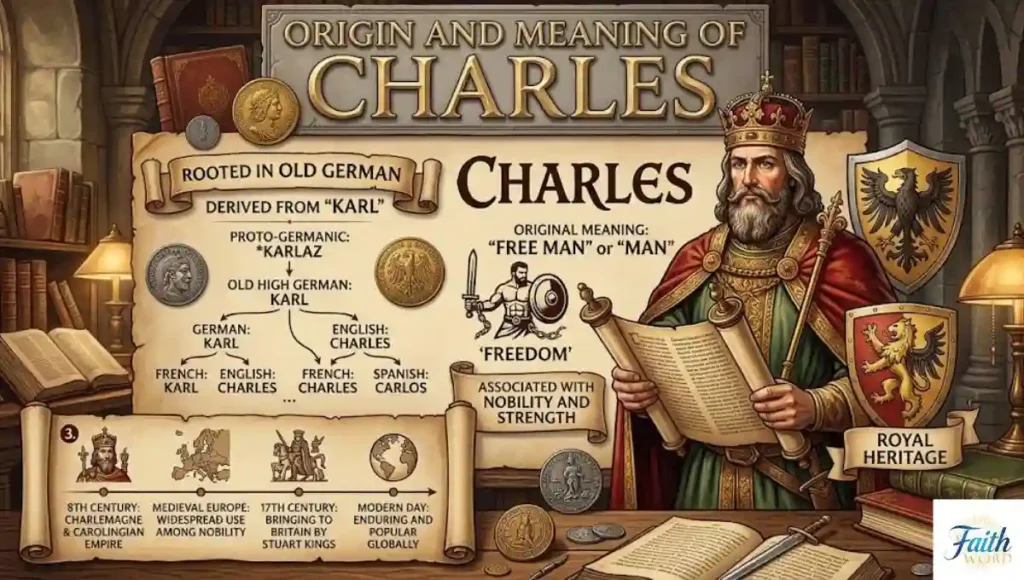
The name Charles originates from the Germanic word Karl, meaning “free man” or “strong man.” Its etymology traces back to a Common Germanic noun karilaz, meaning “free man,” which survives in Old English as ceorl. Historically, a karl occupied a specific social position — not a slave, not a nobleman by birthright, but a free man who owned his land, answered to no master, and earned his place through capability and character.
That distinction carries immediate spiritual weight. A man who is truly free — not because of social rank but because of personal integrity and inner strength — is exactly the kind of man the Bible celebrates from Genesis to Revelation.
Quick Origin Summary of the Name Charles:
| Language / Culture | Form of the Name | Meaning |
| Germanic (Karl) | Karl / Karilaz | Free man, strong man |
| Old English | Ceorl | Free man |
| French / Latin | Carolus / Charles | Man, warrior |
| Christian saints | Saint Charles Borromeo | Devotion and reform |
| Royal heritage | Charlemagne (Carolus Magnus) | Charles the Great |
| Modern English | Charles | Free man, noble character |
The name Charles gained its defining historical momentum through Charlemagne — Carolus Magnus, “Charles the Great” — the Frankish emperor who united much of western and central Europe in the early Middle Ages and shaped the Christian West more than almost any ruler in history. His reign was marked by his efforts to unify Western Europe and bring about the Carolingian Renaissance, playing a crucial role in supporting the Church and emphasizing the importance of education and piety.
Prominently, 13 saints in the Roman Catholic Church have borne the name Charles, reflecting its enduring influence in Christianity. Catholic and Protestant families both favor the name Charles for its spiritual heritage and its unmistakable association with courageous, principled faith.
See More : 70 Effective Prayer for My Boyfriend
Charles and Biblical Themes
The name Charles does not appear letter-for-letter in the Bible — and this article will not pretend otherwise. But in biblical understanding, a name’s power is not limited to whether it appears in the text. It is found in what the name means, what values it embodies, and how those values align with the character God calls His people to reflect. On every one of those measures, the name Charles stands on deeply biblical ground.
1. Freedom in Christ
The most foundational meaning of the name Charles is “free man” — and this single truth opens a direct bridge to the heart of the New Testament gospel. The apostle Paul declared in Galatians 5:1: “It is for freedom that Christ has set us free. Stand firm, then, and do not let yourselves be burdened again by a yoke of slavery.” This is not metaphorical freedom — it is the defining reality of every believer’s identity in Jesus Christ.
The name Charles, rooted in the concept of a free man who answers to no earthly master, beautifully mirrors the New Testament truth that the redeemed are no longer slaves to sin, fear, or the law — but free men and women in the most profound sense possible.
Bible verses that speak directly to the freedom woven into the name Charles:
- Galatians 5:1 — “It is for freedom that Christ has set us free.”
- John 8:36 — “If the Son sets you free, you will be free indeed.”
- Romans 8:2 — “The law of the Spirit who gives life has set you free from the law of sin and death.”
- 2 Corinthians 3:17 — “Where the Spirit of the Lord is, there is freedom.”
- 1 Peter 2:16 — “Live as free people, but do not use your freedom as a cover-up for evil.”
2. Strength and Leadership
The name Charles is equally rooted in the meaning of “strong man” — and the Bible is saturated with the theme of God-given strength as the foundation of every great leader. From Moses leading Israel through the wilderness to Nehemiah rebuilding Jerusalem’s walls to Paul pressing forward in chains, the biblical definition of strength is never self-made pride — it is humble, God-dependent courage that keeps moving when everything says stop.
The name Charles calls every bearer toward this kind of strength — the strength that does not break under pressure, that leads others with integrity rather than ego, and that ultimately points those it leads toward God rather than toward itself.
Biblical figures whose strength reflects the name Charles meaning:
- Caleb — Unwavering faith and courage even when the majority said it was impossible
- Joshua — Bold leadership anchored in God’s command: “Be strong and courageous”
- David — Strength born in obscurity, tested in crisis, refined in worship
- Nehemiah — Leadership defined by prayer, purpose, and unflinching resilience
- Paul — Strength made perfect through weakness, never surrendering his calling
3. Noble Character
The name Charles carries connotations of nobility — not inherited status, but earned dignity. Proverbs 22:1 anchors this perfectly: “A good name is to be chosen rather than great riches, and favor is better than silver or gold.” The name Charles, historically associated with kings and saints who pursued genuine virtue, reminds every bearer that their most valuable possession is not their title but their character before God.
Biblical nobility is not about bloodline — it is about how a person treats the vulnerable, how they use power, whether they are honest when it costs them, and whether they serve God even when no one is watching. That is the nobility embedded in the name Charles.
Charles as a Spiritual Reflection
The spiritual meaning of the name Charles runs through four core pillars that every bearer of this name can claim as a personal calling:
- Freedom — You carry a name that means free man; live as one who is truly free in Christ, not enslaved to sin, opinion, or fear
- Strength — Your name calls you toward God-dependent resilience, not self-reliance; the strength in your name is available through prayer, faith, and surrender
- Leadership — Whether as a father, husband, mentor, pastor, or colleague, the name Charles carries an implicit call to lead others well and with integrity
- Noble character — A good name is worth more than wealth; your name invites you to build a reputation that honors God in every space you occupy
In Christian tradition, the name Charles is associated with Christian values and biblical teachings, emphasizing spiritual liberation, courage, and leadership — the theological essence of this name underscores the importance of trusting in God’s sovereignty and divine leadership, encouraging believers to embody courage, faithfulness, and righteousness.
Historical and Modern Associations

The name Charles has one of the most remarkable historical footprints of any name in the Christian world. Its list of notable bearers reads like a who’s who of Christian history, royal heritage, and moral influence:
| Notable Charles | Era | Contribution to Faith and History |
| Charlemagne (Carolus Magnus) | 742–814 AD | United Christian Europe; advanced Church and education |
| Saint Charles Borromeo | 1538–1584 | Catholic reformer; model of pastoral devotion |
| Charles Wesley | 1707–1788 | Wrote over 6,000 hymns; co-founder of Methodism |
| Charles Spurgeon | 1834–1892 | “Prince of Preachers”; London’s most influential pastor |
| Charles Finney | 1792–1875 | American revivalist; shaped 19th century evangelicalism |
| King Charles I & II | 17th century | Shaped English Christianity and church governance |
| Charles Darwin | 1809–1882 | Scientist whose work continues to challenge and sharpen faith thinking |
Charles Wesley alone — who wrote “Hark! The Herald Angels Sing,” “O For a Thousand Tongues to Sing,” and thousands more — gave the name Charles a permanent place in the worship tradition of the global Church. And Charles Spurgeon, who preached to 10 million people over his lifetime, remains one of the most widely read Christian authors in history.
In the modern world, the name Charles remains a top choice for families seeking a name with traditional values, enduring strength, and genuine Christian heritage. Catholic and Protestant families both favor Charles for its spiritual heritage, and the name remains popular in churches and Christian communities across the world.
Biblical Verses to Reflect On for the Name Charles
Whether you are named Charles, raising a Charles, or simply exploring the biblical meaning of the name Charles, these verses form a powerful spiritual foundation for everything this name represents:
| Theme | Bible Verse | Connection to Name Charles |
| Freedom | Galatians 5:1 | Free man — no longer enslaved, fully liberated in Christ |
| Strength | Joshua 1:9 | Strong man — courageous, God-guided, unafraid |
| Noble character | Proverbs 22:1 | A good name above great riches |
| Leadership | Micah 6:8 | Lead with justice, mercy, and humility before God |
| Purpose | Jeremiah 29:11 | God has plans for the Charles He has made |
| Identity | Ephesians 2:10 | You are God’s masterpiece, created for good works |
| Resilience | Romans 8:37 | More than a conqueror through Christ |
| Service | Mark 10:45 | True greatness in God’s kingdom is servant leadership |
Living Out the Meaning of Charles
Understanding the name Charles is only the beginning. The real invitation is to live its meaning out — in the quiet moments of private discipline and the public moments of courageous action.
Practical ways to live the full meaning of the name Charles:
- Walk in the freedom Christ purchased for you — do not return to habits, fears, or mindsets that enslave
- Develop strength through prayer and Scripture, not through self-confidence alone
- Lead with the servant heart of Christ — the greatest among you is the servant of all (Mark 10:44)
- Guard your character fiercely, knowing that your name and your reputation are your most valuable assets
- Study the Charles Spurgeons and Charles Wesleys who carried this name before you — let their faith challenge your own
- Pray specifically for the qualities embedded in the name Charles: freedom, strength, noble character, and purposeful leadership
- Be the person in your family, workplace, or community who others can count on to stand firm when things get hard
- Let your life make others ask what you believe — that is the testimony the name Charles has always been designed to produce
Naming a child Charles can be seen as a declaration of hope — a prayer that they will grow into a man of genuine freedom, God-given strength, and irreplaceable character. The name Charles is not just an inheritance from history. It is a calling handed forward into the future.
Conclusion
The name Charles is one of the most spiritually rich, historically significant, and biblically resonant names a Christian family can choose — rooted in the Germanic meaning of “free man” and “strong man,” and amplified through fifteen centuries of saints, reformers, preachers, and leaders who carried it with faithfulness and courage.
From the freedom declared in Galatians 5:1 to the strength called forth in Joshua 1:9, from Charlemagne shaping the Christian West to Charles Spurgeon filling London’s Metropolitan Tabernacle with the gospel, the biblical meaning of the name Charles consistently points toward one kind of life: free in Christ, strong in faith, noble in character, and purposeful in leadership.
If you carry the name Charles, you carry an invitation — to live as God always intended a free man to live, in full surrender to the One who makes all men truly free.
FAQs
What is the biblical meaning of the name Charles?
The name Charles means “free man” and “strong man,” connecting biblically to themes of freedom in Christ, God-given strength, noble character, and servant leadership.
Is Charles a biblical name found in Scripture?
Charles does not appear directly in the Bible, but its Germanic meaning deeply aligns with core biblical values of freedom, strength, and faithful leadership.
What does the name Charles mean spiritually in Christianity?
Spiritually, the name Charles represents liberation in Christ, courageous faith, noble character, and a calling to lead others with integrity and God-centered purpose.
What personality traits are associated with the name Charles?
The name Charles is associated with strength, independence, dignity, leadership, moral integrity, resilience, and a natural sense of responsibility toward others.
Why is Charles considered a strong Christian name?
Charles is a strong Christian name because of its meaning as “free man,” its association with 13 Catholic saints, reformers like Charles Wesley and Charles Spurgeon, and its consistent alignment with biblical values.

Welcome to Thefaithword! I’m Abdul Mannan Haider. Christian Faith Writer | 10+ Years Bible Study Experience | Founder of (thefaithword.com)
Sharing prayers, blessings, and biblical wisdom to strengthen your faith.